
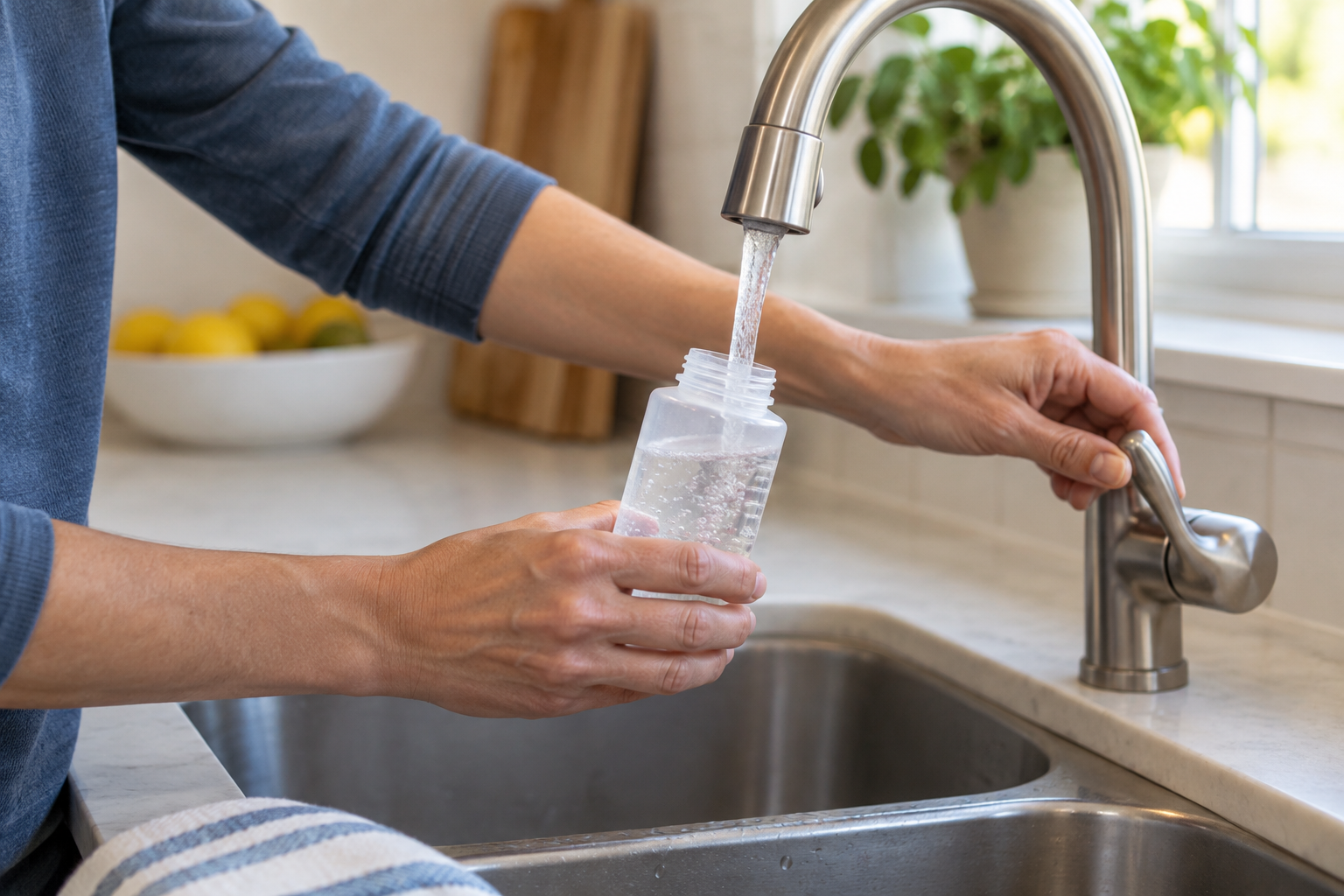
Add tests that match risks near your water well
A well draws from a particular groundwater setting. Bedrock chemistry can make arsenic, uranium, radon, fluoride, manganese, iron, or other naturally occurring constituents important in one region and less useful as routine tests in another. Nearby land uses add a different set of questions. This is why the largest panel a laboratory sells is not automatically the most useful panel for your home.
EPA links possible tests to conditions around a well. Intensive agriculture can point to nitrate, nitrite, pesticides, and coliform bacteria. A landfill, factory, gas station, dry cleaner, or junkyard can point to volatile organic compounds, salts, pH, sulfate, chloride, or metals. Septic systems, fuel storage, mining, oil and gas activity, and road salt create other concerns. The EPA private-well guide gives examples, but local agencies can tell you which ones apply nearby.
Build the added list by asking:
- What does the state or county recommend? Start with EPA's directory of state private-well programs, then follow the current state and local guidance.
- What has been found nearby? Ask about groundwater advisories, known contamination sites, public-system source-water findings, and contaminants associated with the aquifer.
- What is near the well? Note septic systems, livestock, cropland, pesticide use, fuel tanks, mines, industry, landfills, dry cleaners, gas stations, salted roads, and construction.
- What has this well shown before? Discuss repeating prior detections and results that were close to a health-based comparison value.
- What has never been checked? An older or newly purchased property with little history may need a broader first assessment. Some locally important metals or minerals may be checked once or periodically rather than every year.
Use the property history, not just a map
Current land use is only part of the picture. A property may have an older fuel tank, a former agricultural use, a replaced septic system, or a history of nearby commercial activity that is not obvious during a walk around the yard. Well logs, previous owners' reports, state cleanup records, and county or local files may identify questions worth taking to the health or environmental agency.
Prior laboratory reports can also narrow the list. Note which substances were actually analyzed, not only whether the report was described as normal. Record detections, reporting limits, sample points, and whether the water was raw or treated. An old kitchen-tap report and a new raw-water report may answer different questions even when they came from the same property.
PFAS shows why local direction matters. Do not choose a generic PFAS package only because the term is familiar, and do not overlook it where a state identifies a concern. Ask the state environmental or health agency which compounds and method fit the local question and which laboratories are certified for that work. See EPA: PFAS in Private Wells.
Adjust the plan for household health needs
EPA advises considering more frequent testing when small children or older adults live in the home or when someone is pregnant or nursing. A household that includes a person with a weakened immune system should ask that person's health care professional and the local health department whether added microbial precautions or testing are appropriate. A water test cannot diagnose an illness.
Before private-well water is used for infant formula, ask the local health department what should be tested and how recent the results should be. Minnesota's health department, for example, recommends checking well water used for babies for coliform bacteria, nitrate, arsenic, lead, and manganese. It also says to sample the water actually used for drinking or formula, which might come from a kitchen tap, refrigerator dispenser, separate treatment tap, or pitcher. See Minnesota Department of Health: Safe Drinking Water for Your Baby. That is Minnesota guidance, not a national panel, but it illustrates why the people and the sample point both matter.
Test sooner when conditions change
Get prompt local guidance after flooding or heavy runoff, wildfire or other emergency damage, well or pump repair, disinfection, treatment failure, a nearby spill or land disturbance, a groundwater advisory, a sharp change in a routine result, or a sudden change in color, cloudiness, taste, odor, or sediment. EPA specifically recommends immediate testing after significant nearby changes, well-system replacement or repair, water-quality changes, or known local groundwater problems.
A flooded well may involve electrical hazards and damaged equipment. Follow state or local instructions about temporary water use and coordinate inspection, cleaning, repair, flushing, disinfection, and confirmation sampling with the health department, laboratory, and a qualified well contractor. Clear-looking water does not show that contamination is gone.
For a spill, fuel odor, or suspected chemical release, contact the appropriate environmental or health agency before collecting a sample. The laboratory may need special containers, methods, locations, or chain-of-custody procedures. A routine bacteria bottle or general home kit may not answer that question.
Choose a laboratory that can run the analysis you need
Use a state-certified or accredited drinking-water laboratory that accepts samples from private homeowners. Its certification should cover each requested analyte and method, not merely the laboratory in general. EPA directs private-well owners to contact their state program or a certified drinking-water laboratory for testing. Find contacts through EPA's certified laboratory directory.
Before ordering, ask:
- Are you currently certified or accredited for each requested contaminant in drinking water?
- Do you accept homeowner-collected samples, or does any test require a trained sampler?
- Which bottle, preservative, volume, and sample point does each analysis require?
- Must a bottle be chilled, protected from light, or delivered within a particular holding time?
- When will the laboratory accept the samples?
- Will the report show the method, units, reporting limit, and comparison value?
- Who can discuss a detection, exceedance, or unusual change?
Use the laboratory's containers and written instructions. A sterile bacteria bottle may contain a chemical needed for sample handling, and bottles for metals or organic chemicals may contain preservatives. Do not rinse, overflow, substitute, or combine containers unless the laboratory tells you to. Penn State notes that specialized tests may require laboratory staff and that bacteria samples have strict handling and delivery requirements.
Plan the collection around the laboratory's receiving hours rather than collecting first and asking later. Different analyses can require different bottles, preparation, preservation, and delivery timing. Put each bottle's label and instruction sheet with the sample map before collection day. If an instruction is unclear, call the laboratory instead of adapting a method from another bottle or an older test.
Ask how the laboratory wants recent disinfection, filter changes, treatment service, plumbing work, or an unusual event recorded. Those details can affect the sampling plan and the way a result is understood. Keep the order confirmation and the laboratory contact name with the final report.
Plan what each sample should answer
The right faucet depends on the question. Sketch the water path from the well through the pressure system, treatment devices, water heater, and drinking taps. Confirm the route from records or visible piping without opening equipment or changing unfamiliar valves.
Raw water
A sample before a softener, filter, ultraviolet unit, reverse-osmosis system, or other treatment describes water entering from the well and pressure system. It can help investigate the source, compare historical raw-water results, or support treatment planning. A pressure-tank spigot may be before treatment, but verify its location and ask whether the laboratory accepts it. Avoid hoses, dirty outlets, and rarely used taps unless instructed otherwise.
Treated drinking water
A sample from the tap people use describes the water after treatment and household plumbing at that outlet. Minnesota recommends sampling the cooking and drinking faucet and, when treatment is present, testing after treatment. See Minnesota Department of Health: Well Testing, Results, and Options.
Paired and plumbing-related samples
When checking treatment, the laboratory may call for matched samples before and after a device. Label each location clearly. A post-treatment sample does not show what entered the device, and a raw sample does not describe what reaches the household tap.
Lead and copper can enter water from plumbing, so their collection protocol may intentionally differ from a flushed source-water sample. Penn State describes a first-draw approach for a plumbing-corrosion investigation. Do not apply one sampling protocol to every analyte. Ask the laboratory for instructions that match each question.
Record the well or property identifier, exact faucet, raw or treated status, upstream treatment, collection date and time, sampler's name, and recent flooding, repair, disinfection, or service. Also note any flushing, stagnation, or field measurement the laboratory required.
Before collecting, label the purpose of each location in plain language: source water before treatment, treated kitchen water, or a plumbing-specific point. Confirm which outdoor and basement taps bypass treatment. Pipe routing is not always obvious, and a faucet that looks close to the pressure tank may still be downstream of equipment.
When comparing two locations, collect them as the laboratory directs and keep the conditions as comparable as possible. Record the order and time. Do not operate bypass valves simply to create a sample point, and do not open pressurized housings. If the route is unclear, ask the installer, plumber, well professional, or laboratory to help identify a suitable point.
Know what home tests can and cannot do
A strip, color block, handheld meter, or mail-order screening package may help flag a narrow issue or track an operational measure such as pH, hardness, or chlorine. Its limits may include an unsuitable detection level, a broad color range, interference from other substances, user timing or lighting errors, no validated result for the chemical form of concern, and no documented sample custody.
The University of Arizona Cooperative Extension guide discusses variable precision and accuracy, limited ranges, interference, detection limits, and user error. Treat a home result as screening unless the responsible agency accepts that method. Confirm a consequential result through a certified laboratory. A strip that reports several reassuring readings says nothing about contaminants it did not test.
Be cautious when a free test leads directly to a treatment sales pitch. Use an independent laboratory to define the problem before comparing equipment. Begin with testing guidance, then use treatment guidance after the contaminant, concentration, flow needs, and treatment goal are understood.
Read the report before making decisions
- Verify the sample. Check the property, well identifier, faucet, raw or treated status, and collection date.
- Read the full analyte name. Different reported chemical forms may not be directly comparable.
- Check the units. Use the report and agency guidance rather than converting from memory.
- Understand a non-detect. It generally means the analyte was not found at or above the laboratory's stated detection or reporting limit. It does not mean absolute zero.
- Find the applicable comparison value. EPA standards govern public water systems, not automatically each private well. State health limits, advisories, action levels, or private-well rules may differ.
- Separate health-based concerns from aesthetic or operational issues. Taste, staining, scaling, and corrosion can matter without carrying the same meaning as a health-based exceedance.
- Compare prior reports. A marked change may justify checking the sample, well, plumbing, treatment, and nearby conditions even when the value remains below a cited benchmark.
Read laboratory comments and qualifiers alongside the number. A result may be estimated, affected by the sample condition, or reported with a limit that matters for comparison. If the analyte name, units, or comparison value on the report do not match the guidance you are using, stop and ask the laboratory or agency to reconcile them.
Do not collapse the report into a single pass or fail label. One result may call for prompt agency guidance, another may indicate an operational issue, and another may simply become a baseline for future comparison. The report covers only the submitted samples and requested analyses.
Ask the laboratory and state or local private-well program to explain the result in context. Water symptoms do not identify a contaminant. If someone is ill, contact a qualified health professional and report the separate water concern to the appropriate health agency.
When a result is concerning
Follow any immediate instructions on the report or from the health department. Temporary water-use guidance depends on the contaminant. A general response cannot cover both microbial and chemical concerns. Minnesota's guidance, for example, distinguishes nitrate from problems for which boiling may be useful. See Well Testing, Results, and Options.
Ask whether the result and sampling protocol need confirmation, where another sample should be collected, and whether protective action should begin first. Then investigate the source or pathway. A loose cap, damaged casing, flood, treatment bypass, plumbing corrosion, septic problem, or nearby release does not call for the same response.
Correct a source or structural problem where possible before treating the symptom alone. If treatment is considered, base the comparison on the measured contaminant, water chemistry, household flow, and a verified certification claim. Retest at the location that answers whether repair, disinfection, or treatment achieved its purpose, and set a verification schedule with the laboratory, agency, or qualified professional. EPA recommends contacting the public health department and retesting to confirm a contaminant and its concentration when a sample exceeds a health standard.
Keep records that make the next test useful
Save the full laboratory report, not only a screenshot or one result. Keep the well construction log, pump and casing work, pressure-system and plumbing work, inspection and disinfection records, septic service, submission forms, sample locations, treatment records, filter changes, and notes about floods, spills, construction, advisories, or unusual water changes.
Track the same analytes, units, laboratory, and sample points when practical. Trends are easier to interpret when the method and location stay consistent. EPA also advises keeping accurate maintenance records, including disinfection and sediment-removal work.
Add a short note to each report describing ordinary conditions on collection day. Include recent rain, drought, power loss, pump work, plumbing changes, treatment service, and anything unusual at the wellhead. Keep photographs or a simple diagram showing the sample points and the order of treatment equipment. This context can prevent a future report from being compared with a sample collected for a different purpose.
If you are buying a home, documenting conditions before nearby development, or preparing for a possible dispute, ask whether an independent professional sample and formal chain of custody are warranted. A homeowner-collected sample may work for routine care but may provide weak evidence in a dispute.
Make your annual plan ahead of collection day
Use this checklist with the laboratory or local well program. It keeps the annual baseline, local risks, sample points, and follow-up in one place.
Before ordering
- Review the last report and any prior detections.
- Check current state, tribal, county, and local recommendations.
- Ask about local geology, aquifer concerns, and nearby land uses.
- List floods, repairs, disinfection, treatment changes, and visible water changes since the last sample.
- Discuss household changes that may affect the testing schedule.
- Confirm the annual baseline, locally recommended tests, prior detections to repeat, and any periodic test due this year.
Map the bottles
| Test | Sample point | Raw or treated | Collection instructions | Delivery deadline |
|---|---|---|---|---|
| Annual baseline | ||||
| Local risk | ||||
| Prior detection | ||||
| Event-related |
On collection day
- Use only the laboratory's containers and instructions.
- Record the sample point, time, raw or treated status, and recent events.
- Preserve and deliver each sample exactly as directed.
- Save the submission form and receipt or tracking details.
When results arrive
- Verify the sample identity, location, and date.
- Review names, units, reporting limits, and comparison values.
- Compare the full report with prior years.
- Call the laboratory or health department about detections, exceedances, or marked changes.
- Follow contaminant-specific guidance, confirm results when directed, and investigate the source or pathway.
- Retest after corrective work when directed, file the report, and set the next reminder.
Annual testing is a checkpoint, not a guarantee about the months ahead. Repeat a modest baseline, add tests that fit the property, and respond when conditions change. For an unexplained taste, odor, stain, or other clue, use the water clues guide or the guided Symptom Finder. For local contacts, use the official state-program directory cited above. Well Water Clarity does not operate a professional directory.
When this year's results arrive, use the test results checker to compare them with EPA levels.
Where this guidance comes from
- U.S. Environmental Protection Agency. Protect Your Home's Water
- U.S. Environmental Protection Agency. Potential Well Water Contaminants and Their Impacts
- U.S. Environmental Protection Agency. Private Drinking Water Well Programs in Your State
- U.S. Environmental Protection Agency. Contact Information for Certification Programs and Certified Laboratories for Drinking Water
- U.S. Environmental Protection Agency. PFAS in Private Wells
- Minnesota Department of Health. Well Testing, Results, and Options
- Minnesota Department of Health. Safe Drinking Water for Your Baby
- Penn State Extension. Testing Your Drinking Water
- University of Arizona Cooperative Extension. Well Testing and Understanding the Results