
Well Care · Owning a Well
Your Pressure Tank Explained: What It Does and What to Watch For
What a well pressure tank does, how it works with the pump and pressure switch, signs it may need attention, and what homeowners can observe safely before calling a professional.
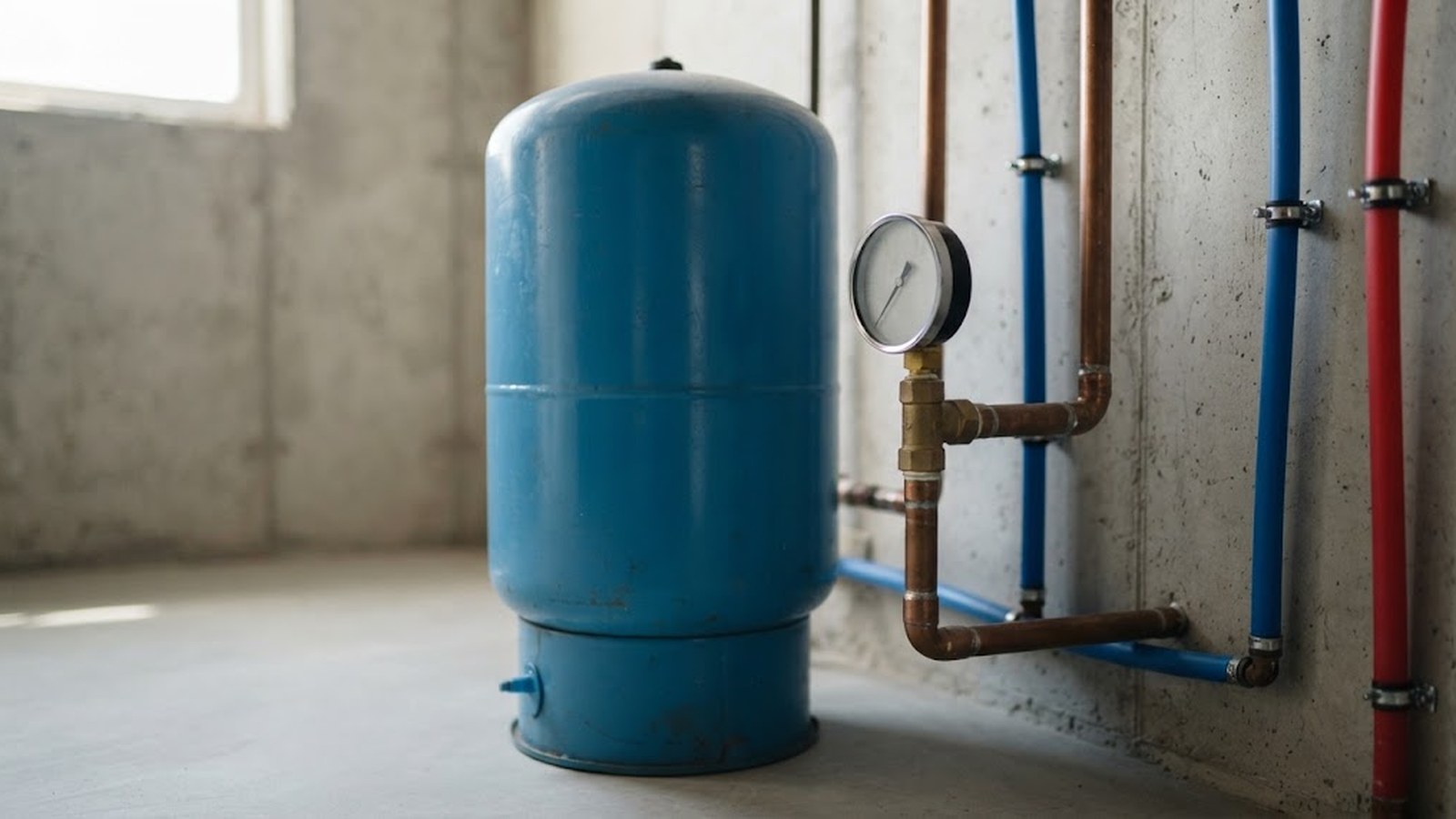
If you have a private well, there is a good chance you have walked past your pressure tank dozens of times without thinking much about it. It is usually a tall cylinder in the basement, garage, or utility room, often painted blue, gray, white, or tan. It does not make noise, it does not have a screen, and it rarely asks for attention. But it plays a quiet, essential role in how your water system works, and it has a big influence on how long your pump lasts.
This article explains what the pressure tank does, how it works with the pump and pressure switch, what can go wrong, and what you can safely observe as a homeowner. It is written to help you understand your system and describe problems clearly, not to replace a well professional. Pressure tanks hold water and air under pressure and are connected to electrical controls, so adjustments and repairs belong with someone qualified.
See what your pressure tank does for your pump and faucets
A pressure tank has three main jobs:
- Deliver water under pressure so water flows when you open a faucet, even when the pump is not running.
- Reduce how often the pump starts. Starting is hard on pumps. The tank lets the pump run in fewer, longer cycles instead of many short ones.
- Smooth out the system. It helps buffer pressure changes and handles small water uses, like a quick hand wash, without starting the pump at all.
Without a pressure tank, or with one that is not working properly, the pump would have to start nearly every time anyone turned on a tap. That rapid on-and-off pattern is called short cycling, and it is one of the main reasons pumps and controls wear out early.
Follow the water and air cycle so you know what is normal
Most modern pressure tanks have two chambers inside: one for water and one for air. A flexible bladder or diaphragm separates them. The air side is filled with compressed air at the factory or during installation. This air is called the pre-charge.
The basic cycle goes like this. The pump runs and pushes water into the tank, and as water enters, it squeezes the air cushion so pressure in the tank rises. When pressure reaches its upper setting, the pressure switch turns the pump off. Then you open a faucet, and the compressed air pushes on the bladder, which pushes water out of the tank and through your plumbing. As water leaves and the air expands, pressure drops. When pressure falls to its lower setting, the pressure switch turns the pump back on, and the cycle repeats. Knowing this rhythm makes it easier to tell a healthy system from one that is struggling.
Some older tanks do not have a bladder. In those, water and air are in direct contact. Over time, the air can gradually dissolve into the water, and the tank becomes "waterlogged," meaning it has too much water and not enough air to provide a cushion. These tanks often need periodic attention that bladder tanks do not.
See why a big tank gives you less usable water than you expect
People are often surprised by how little water a pressure tank delivers between pump cycles. A tank might be the size of a small person, but the amount of water it pushes out before the pump turns back on is only a fraction of its total volume.
That usable amount is called drawdown. It depends on the tank's size, its pre-charge, and the pressure switch settings. The rest of the tank's volume is taken up by the compressed air cushion and by water that stays in the tank.
This matters for a few reasons:
- It is not a water reserve. A pressure tank will not carry you through a power outage for long. It may provide enough for a few flushes or a bit of drinking water, but not much more. Our power outage article covers planning for that.
- It affects pump cycles. A tank that is too small for the system, or one that has lost its air charge, delivers less drawdown, which means the pump starts more often.
- It is why tanks are sized. Professionals choose tank sizes based on the pump, the system, and how the household uses water.
Understand the pre-charge so you know what to ask a pro to check
The pre-charge is the air pressure on the air side of the tank when there is no water pressure on the water side. It has to be set correctly in relation to the pressure switch settings for the tank to work as designed.
Checking and adjusting the pre-charge involves turning off power to the pump, draining pressure from the system, and measuring the air pressure at a valve on the tank, much like a tire valve. It is a routine task for a well professional. Some experienced homeowners learn to do it, but it requires care: the system involves electricity and water under pressure, and incorrect settings can cause problems. If you are not confident, have a professional do it and show you the settings for your records.
Know what the pressure switch controls and why to leave it closed
The pressure switch is usually a small gray or black box mounted on the pipe near the tank. It senses system pressure and turns the pump on and off. It has two settings: the pressure at which the pump turns on (sometimes called cut-in) and the pressure at which it turns off (cut-out).
The tank and the switch work as a team. If the switch settings change, the tank's pre-charge may need adjusting too, and vice versa. That is one more reason to leave adjustments to a professional.
The switch contains live electrical contacts. Do not open its cover unless you are qualified and the power is off.
Read your gauge to record a baseline for your system
The pressure gauge is the one part of the system that lets you see what is happening. It is usually a small round dial on the pipe near the tank or switch.
Here is a simple way to get to know your system:
- Make sure no water is being used in the house.
- Look at the gauge and note the pressure.
- Have someone open a faucet, like a bathtub tap.
- Watch the needle slowly drop as water flows.
- Note the pressure when the pump turns on. You may hear a click from the switch and a hum or other sound.
- Have them close the faucet.
- Watch the needle rise until the pump turns off. Note that pressure.
- Also note roughly how long the pump ran and how long it took the needle to drop before the pump started.
Write these numbers down with the date. They are your baseline. If the pattern changes over time, it is useful information for a professional.
A gauge that seems stuck, reads zero when there is clearly pressure, or has fogged up may itself be faulty. Gauges are inexpensive, but replacing one involves the pressurized system and is best done by, or with guidance from, a professional.
Spot the signs your pressure tank needs attention
Pressure tanks can last many years, but they do not last forever. Here are signs worth noticing and reporting to a well professional.
Catch rapid pump cycling early
If the pump turns on and off every few seconds while water is running, or you hear the pressure switch clicking repeatedly, the tank may have lost its air charge or the bladder may have failed. This is one of the most common signs of tank trouble, and it is hard on the pump. It is worth addressing soon.
Notice pressure that surges and fades
If water pressure at the faucet surges and fades noticeably, especially in a rhythm, the system may be short cycling.
Recognize the clues of a waterlogged tank
With the power to the pump off and the system at rest, a professional may check the tank's condition. Some owners notice that a tank that should have an air-filled top feels uniformly heavy or cold from top to bottom, which can sometimes suggest waterlogging. This is only a clue, not a diagnosis.
Leave water at the air valve to a professional
On a bladder tank, the air valve should release air when pressed, not water. If a professional checks it and water comes out, the bladder may have failed. This is a professional check, since it involves the pressurized system.
Check for leaks, rust, and dampness
Look for rust on the tank, especially at the bottom, seams, or fittings. Look for dampness or water on the floor beneath it. A leaking tank should be looked at promptly.
Report bulging or visible damage
Any bulging, denting, or visible deformity is a reason to have the tank checked.
Listen for banging or vibration
Unusual banging, hammering, or vibration in the pipes when the pump starts or stops can point to a variety of issues, including tank or valve problems.
Find out how old your tank is
Knowing roughly when the tank was installed helps you anticipate replacement. If you do not know, look for a label or date code, or ask a professional to estimate.
See how short cycling damages your pump and controls
Short cycling is not just annoying. When the pump starts many more times than it should, it can wear out the pump motor faster and wear out the pressure switch contacts faster. It can also stress control boxes and electrical components, use more electricity, and cause pressure fluctuations in the house.
In other words, a tank problem left alone can turn into a pump problem, and pumps are usually much more expensive and disruptive to replace than tanks. When you notice signs of short cycling, calling a professional sooner rather than later is usually the economical choice.
Know what you can safely do and what to leave to a pro
Your role as an owner is observation, protection, and communication. Most homeowners can reasonably take on a handful of habits. Know where the tank, gauge, switch, and shutoff valves are; our first 30 days guide explains how to find them. Record your baseline pressures and check them a few times a year, so a change stands out. Keep the area around the tank clear and dry, without boxes stacked against it or chemicals stored near it. During routine checks, look for leaks, rust, and dampness, and listen for rapid cycling. Keep records of when the tank was installed and serviced, which helps a professional later. If the tank is in an unheated space, protect it from freezing; our winter article covers this. And when you notice changes, call a professional.
Because the system combines electricity with pressurized water, most homeowners should leave several jobs to a professional: opening the pressure switch, adjusting pressure switch settings, and checking or adjusting the pre-charge unless trained. The same goes for replacing the tank, gauge, or switch, any electrical work, and draining or repressurizing the system for service.
Check your tank each season to catch problems early
A quick glance at the tank fits naturally into your seasonal routine:
- Spring: Check for any damage from a cold winter, especially if the tank is in a garage, crawlspace, or well house. Look for dampness and rust.
- Summer: If you irrigate heavily, pay attention to how often the pump cycles during long watering sessions.
- Fall: Before cold weather, make sure the tank and nearby pipes are protected from freezing if they are in an unheated space.
- Winter: After power outages, confirm the system repressurizes normally and the pump does not cycle rapidly when power returns.
Know what to expect when your tank is replaced
When a pressure tank needs replacement, a well professional will typically turn off power to the pump and relieve pressure in the system. They then disconnect and remove the old tank and choose a new one sized for your system. After setting the pre-charge to match the pressure switch, they install the new tank and reconnect the plumbing, then restore power and check the system's operation. Knowing the order helps you see that the work is being done carefully.
It is also a good time to ask whether the pressure switch, gauge, or related valves should be replaced at the same time, since they are often close to the end of their life when the tank is.
After any work that opens the plumbing, ask the professional whether they recommend disinfecting or testing the water. Our Well Care page and testing guide explain when testing after repairs makes sense.
Ask these questions before a tank is replaced
- What size tank do you recommend, and why?
- Is the new tank sized for how my household uses water?
- What will the pre-charge and switch settings be?
- Should the pressure switch or gauge be replaced now too?
- Is there any sign the pump was affected by short cycling?
- Is there a warranty on the tank and the work?
- Should I test or disinfect the water after this work?
Write the answers down and keep them in your well records.
Match your tank's location to the care it needs
Pressure tanks end up in all sorts of places, and the location affects how you care for them.
Basements. The most common spot in many regions. Basements are usually protected from freezing, easy to reach, and near the point where the water line enters. Watch for dampness, flooding risk, and clutter that builds up around the tank over time.
Garages. Convenient, but garages can get cold. In cold climates, a garage tank may need protection from freezing. Garages also tend to hold fuel, chemicals, and vehicles, so keep the tank area clear and protected from bumps.
Crawlspaces. Tanks in crawlspaces are hard to see and easy to forget. They can be exposed to cold and moisture. If yours is in a crawlspace, make a point of checking it during seasonal walk-arounds, and make sure the access is clear for service.
Well houses and pump houses. A small separate building near the well keeps equipment out of the main house but adds the building itself to your maintenance list. Well houses need to stay dry, protected from freezing, and free of stored chemicals.
Utility closets. Tanks in finished spaces are easy to reach but can be squeezed in tightly. Make sure there is room for a technician to work and that a leak would not damage finished floors or walls without being noticed.
Wherever your tank lives, three things matter most: it should be protected from freezing, protected from physical damage, and accessible for service.
Keep a simple tank log to spot slow changes
A pressure tank log does not need to be elaborate. A single page in your well records binder works. For each entry, record:
- The date
- The pressure when the pump turns on
- The pressure when the pump turns off
- Roughly how long the pump runs to refill after a faucet is opened for a set time
- Anything unusual: clicking, rapid cycling, noise, dampness, rust
- Any service performed, and by whom
Two or three entries a year is plenty. Over time, the log shows whether anything is slowly drifting, and it gives a professional real information to work with.
Describe a problem clearly so help arrives prepared
When you call a well professional about a possible tank issue, specific observations help them understand what is going on before they arrive. Compare these two descriptions:
"The water pressure is weird."
versus
"When the shower is running, the pump clicks on and off every few seconds, and the pressure gauge swings between two numbers quickly. It started about two weeks ago. The tank was installed about eight years ago according to our records. There is no water on the floor."
The second description tells the professional a great deal. It points toward a likely area of the system, gives a timeline, provides the tank's age, and rules out a visible leak. It helps them bring the right parts and gives you a better chance of a quick fix.
Sort pressure tank myths from facts
"A bigger tank means more stored water for emergencies." A bigger tank does deliver more drawdown, but it is still not an emergency water supply. Plan separately for outages.
"If the water is flowing, the tank is fine." A tank can lose its air charge and still let water flow. The sign is usually rapid cycling, not a lack of water.
"Tanks never need attention." Bladder tanks need less attention than older designs, but they can still lose pre-charge or fail over time.
"I can just add air with a bike pump whenever." Adding air without first draining the system and understanding the settings can make things worse. Pre-charge is set with the system at zero water pressure and in relation to the switch settings.
"Pressure tank problems are just about water pressure." As explained above, they can shorten the life of the pump and controls.
See how your pressure tank connects to water quality
A pressure tank is mostly a mechanical part, but it has some connections to water quality:
- Sediment can collect in some tanks over time, especially if the water carries particles.
- Older non-bladder tanks can sometimes contribute to certain tastes or odors as water sits in contact with air and metal.
- The tank's drain valve is sometimes used for sampling raw water before treatment. Our guide on how to collect a water sample explains where to sample and why.
- After tank replacement, the plumbing has been opened, which is one reason professionals sometimes recommend disinfection and testing afterward.
If you notice a change in water quality after tank work, mention it to the professional and consider testing.
Quick answers to common pressure tank questions
How long do pressure tanks last?
It varies with the tank, water conditions, and how the system is set up. Keeping a record of when your tank was installed helps you anticipate replacement. A professional can assess its condition.
Can a pressure tank be repaired, or does it have to be replaced?
Some issues, like a low pre-charge, can be corrected. Others, like a failed bladder or a leaking tank, usually mean replacement. A well professional can tell you which applies.
Does a bigger tank mean better water pressure?
Not exactly. Pressure is set mainly by the pressure switch. A properly sized tank reduces how often the pump starts and smooths out the system.
Is it normal for the tank to sweat?
Condensation can form on tanks in humid spaces because the water inside is cool. It is usually harmless, but it can look like a leak. Wipe it dry and watch whether water keeps returning at a seam or fitting.
Review the key points and take your next step
Your pressure tank stores a small amount of water under pressure, delivers it to your faucets, and protects your pump by reducing how often it has to start. It works hand in hand with the pressure switch and depends on a correct air pre-charge. The most common sign of trouble is rapid pump cycling, which is worth addressing promptly because it can wear out more expensive parts.
As a homeowner, your job is to know where the tank is, keep an eye on the pressure gauge, look for leaks and rust, protect the tank from freezing, keep records, and call a professional when something changes. That small amount of attention helps your whole system last longer and gives you a much clearer picture when it is time to ask for help.