
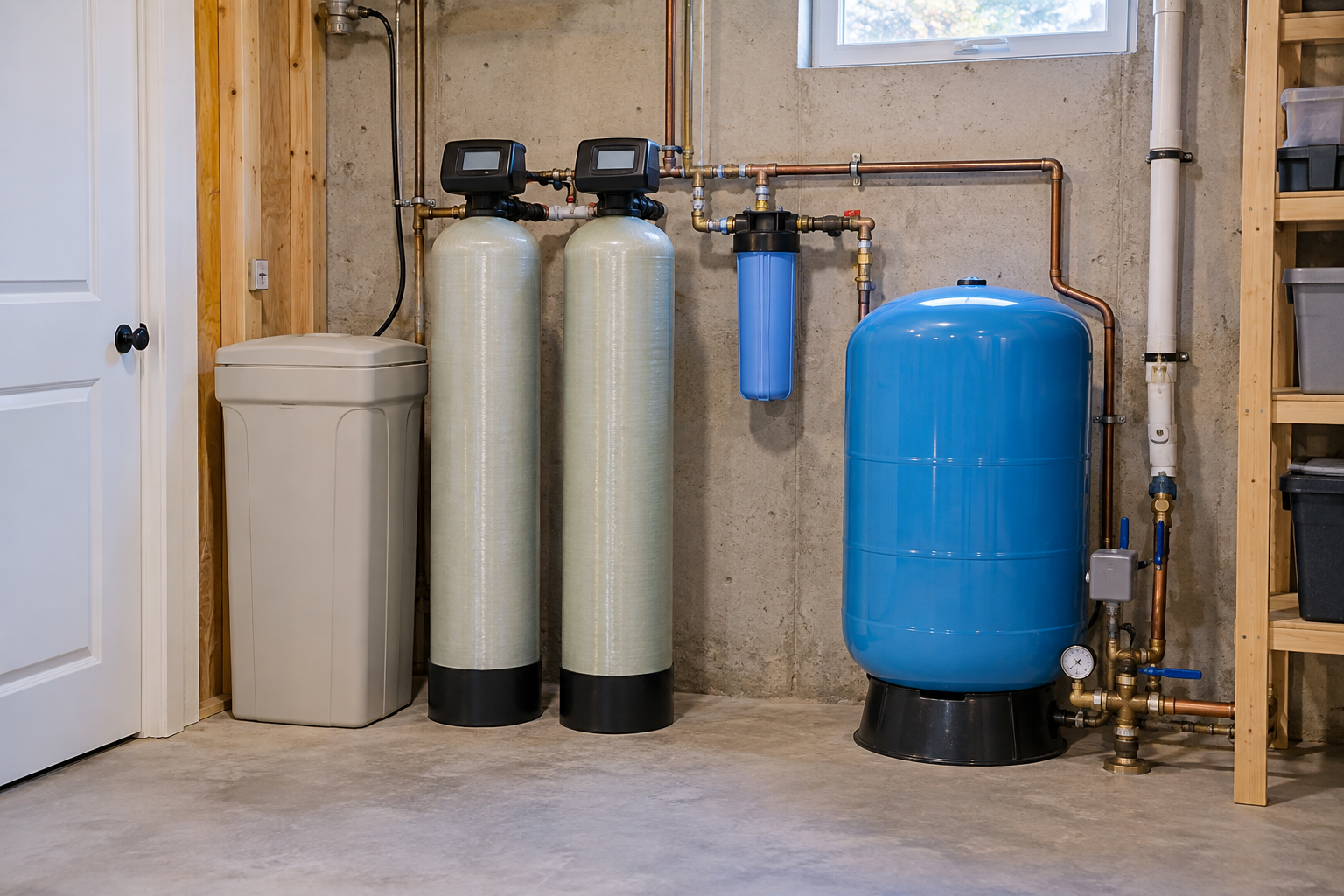
Start with what your test results actually show
A private well is not public water. There is no utility monitoring it between tests, and the source can change with weather, seasons, and the well itself. That is why treatment is compared against a laboratory report, not against a symptom.
Define the problem and the measured result first. Ask the laboratory what the report shows, what the sample location was, and whether the result is consistent with how you normally use the water. The same report can point to several possible causes, so the contaminants and lab results guide explains how a single number leads to focused questions rather than an instant product.
Set a clear goal for treatment before you compare equipment. A goal such as "stop the orange staining on the fixtures" or "reduce the rotten-egg odor at the utility sink" gives you and a professional something measurable to check later. A goal such as "make the water better" cannot be confirmed after installation, because nothing defines "better."
If a symptom started suddenly, rule out an urgent condition before choosing equipment. Flooding, sewage, chemicals, a damaged well, or illness changes everything. The cloudy well water guide and the iron staining guide describe when to stop comparing and get local help.
Not sure which results matter? Run your report through the test results checker first.
Know what treatment can change, and what it cannot
Every treatment device removes or changes something. No device removes everything, and no device fixes a well problem, a damaged pump, a failing casing, or contaminated ground water near the well. The well maintenance guide covers the source-side care that treatment cannot replace.
- Treatment changes what leaves the tap. It can remove particles, reduce certain chemicals, soften hard water, oxidize dissolved iron and manganese, or inactivate microorganisms. It selects for what it is designed to handle.
- Treatment does not repair the well. Sand that comes from a worn screen, declining yield, or turbid water after heavy rain usually calls for a well evaluation, not a larger filter.
- Treatment has a maintenance cost. Media, membranes, lamps, cartridges, salt, and professional service repeat on a schedule. The ongoing cost often matters more than the sticker price.
- Treatment needs matched conditions. Performance depends on the water you feed it, the flow you draw, and how faithfully you maintain it. Our affiliate disclosure explains how this page stays independent of any sales pitch.
Be honest about this before you buy: there is no single best system for every well. A system that a neighbor swears by can be the wrong fit for a different well with a different report. The honest comparison is by measurable result, household flow, and upkeep, not by reputation.
Choose with results, flow rate, and upkeep in mind
Three practical factors separate a workable system from a frustrating one, and none of them is the product name alone.
- Measured results
- Whatever contaminant you want to reduce must appear on tests, and the equipment must be designed for that contaminant at the levels you actually have. Before-and-after sampling at a clearly labeled tap is the honest way to confirm a change. See the water testing plan for when to sample raw water and treated water.
- Household flow
- A treatment device reduces pressure and only handles so many gallons per minute. A unit sized for light use cannot keep up when several fixtures run at once. Flow needs help a professional match equipment to your home; they do not by themselves prove a system is correct.
- Upkeep you will actually do
- A cartridge you never replace, a lamp you never change, or a softener you never refill performs poorly. Choose a system whose maintenance you can keep up, or plan for professional service before you commit.
Use the Symptom Finder to connect an observed clue to the tests and guidance that fit, then bring those results to the comparison below.
Compare treatment categories side by side
These are the main treatment categories a homeowner is likely to evaluate. A home often needs more than one working together. Read the table for the shape of each category, then the notes below for what to confirm before you compare.
| Category | What it is designed to address | Usual upkeep |
|---|---|---|
| Sediment filtration | Sand, silt, and other suspended material that make water cloudy, gritty, or hard on fixtures | Replace cartridges on the maker's schedule; a darkening or fast-plugging cartridge shows the source may be changing |
| Activated carbon | Certain tastes, odors, and organic chemicals, including some chlorine byproducts and volatile organics | Replace or regenerate media on schedule; performance drops as the carbon capacity is used up |
| Water softening / ion exchange | Hardness minerals that form scale on hot-water systems; some specialized resins address specific dissolved metals or other ions | Add salt and regenerate on schedule; check that the exchange capacity still fits the household load |
| Reverse osmosis (point of use) | A broad range of dissolved contaminants at one tap, producing a separate waste stream | Replace prefilters, the membrane, and the postfilter per the maker; keep the waste and storage behavior in mind |
| UV disinfection | Microorganisms, when the flow and dose are matched to the water that actually passes through the unit | Replace the lamp on schedule, keep the quartz sleeve clean, and feed the unit water it is rated to handle |
| Oxygen / oxidation systems | Dissolved iron, manganese, and certain sulfide smells that develop color or odor after exposure to air | Backwash, air supply, and media renew on schedule; local conditions affect how often media needs attention |
Sediment filtration
Sediment filters capture suspended particles as water passes through. Micron rating, active filter area, pressure loss, and replacement frequency all matter, and they trade off against each other. A very fine cartridge can cut flow and slow the whole house. Ask what the filter is protecting and what is actually loading it, so it does not hide a source problem. See the pressure and pump discussion in the cloudy water guide.
Activated carbon
Activated carbon works by adsorption; it collects certain organic chemicals, tastes, and odors onto its surface. Performance depends on the specific contaminant, the amount of carbon, the contact time, and how much has already been adsorbed. Carbon's capacity is finite, so timely replacement is not optional. It is not a general-purpose purifier, and it is not a substitute for disinfection.
Water softening / ion exchange
A conventional softener exchanges hardness minerals for sodium or potassium on a resin bed, which is then regenerated. The benefit, in homes with hard water, is less scale and easier cleaning rather than a change in safety. Specialized ion-exchange resins exist for particular ions, but no single exchange resin solves every dissolved issue, and the exchanged mineral affects your diet and plumbing, so ask what is being substituted and what that means for your household.
To size a softener from your test results, including the extra capacity iron and manganese use up, try the water softener size calculator.
Reverse osmosis
Reverse osmosis pushes water through a membrane that rejects a broad range of dissolved contaminants, so it is usually installed as a point-of-use system under a sink for drinking and cooking water. It produces a waste stream, needs a storage tank, and its filters need replacement. It treats what reaches that one tap; it does not treat the whole house unless the system is designed for it.
UV disinfection
Ultraviolet treatment inactivates microorganisms only as water flows past the lamp, so the flow rate and dose must be matched to the water that actually passes through the unit, and the water must be clear enough for the light to reach the organisms. It treats only what flows through it, and cloudy or untested incoming water reduces its effectiveness. It adds nothing to the water, so taste is unchanged.
Oxygen / oxidation systems
Dissolved iron and manganese can leave the tap looking clear and only develop color or particles after contact with air, and certain sulfur odors behave in similar ways. Oxygen-based and other oxidation systems convert those dissolved forms into material that can then be filtered or settled out. They need backwashing and renewed media over time. These systems are matched to particular dissolved conditions, which is exactly why a laboratory result matters before buying one. See the iron staining guide and the sulfur odor guide.
Decide between whole-house and point-of-use treatment
Two formats change what treatment actually accomplishes, independent of the technology inside.
- Whole-house (point of entry) treats every tap, including showers, washing, and fixtures. It is appropriate when the reason to treat, such as staining fixtures or scale in hot-water systems, affects the whole home or when a contaminant is present throughout the plumbing.
- Point of use treats one tap, usually the kitchen drinking and cooking tap. It can be a focused, lower-cost answer when the goal is water for drinking and cooking only, because it does not attempt to treat the water used for laundry and bathing.
Choose the format by asking what outcome you need and which taps must change. A whole-house system that overshoots the goal costs more in equipment and upkeep for fixtures that never needed it, while a point-of-use system leaves the rest of the home unchanged.
Understand what certification does and does not prove
Relevant third-party certification is a useful screen, but read carefully. Certification programs, such as those administered under NSF/ANSI standards by accredited bodies, verify that a device meets a stated performance claim for a specific contaminant or reduction, that it withstands its rated capacity, that its materials are safe, and that its maintenance claims are supported.
- Certification verifies a claim, not your water. It means the device met the standard under test conditions. Your well has its own measured levels, so certified performance still has to be matched to your results and flow.
- The standard number should fit the claim. A filter certified for one effect is not certified for every effect. Ask which specific contaminant, reduction, and capacity the certification covers for the model you are shown.
- Certification for drinking-water devices differs from certification for other uses. Confirm a device carries the standard that matches your intended use, rather than assuming one badge covers every purpose.
No certification replaces testing, and no certification makes a device universal. It is one input into the comparison, not a shortcut around a laboratory report.
Ask a treatment professional the right questions
Bring your laboratory report, a description of household size and water use, and a list of what bothers you. Ask the same questions of any installer or seller so you can compare answers:
- Which contaminant or condition on my report does this system actually reduce, and what result should I expect after installation?
- What certification covers this specific model for that contaminant, and what reduction and capacity does it claim?
- How much flow does my household need, and does this system supply it at the pressure I care about?
- Would more than one system, or a specific order of systems, be appropriate for my results rather than one device?
- Which parts wear out, how often, what do they cost, and can I maintain this myself or must I schedule service?
- How will we confirm it worked, and what before-and-after samples do you recommend at which taps?
- What happens to the water the system rejects, such as backwash or reverse-osmosis waste?
- Is a permit, inspection, or approval needed for this installation in my area?
A seller who cannot point to measured results, a relevant certification, and a maintenance plan for a specific model is not yet giving you enough to make a decision. Start the comparison from your report, not from a product.
Plan for upkeep before you buy
Write the maintenance expectations into the decision. Before you choose, confirm from the maker's literature:
- which components need regular attention and how often
- what it takes to replace, refill, backwash, or renew each one, and what those materials cost
- whether the maintenance schedule changes if water use is high or low
- what the warranty covers and what it excludes
- how to prove a change actually happened, with before-and-after records
Keep a simple log of purchases, replacements, and service dates. A dated record helps a professional see whether poor performance is an equipment fault or a maintenance gap, and it is the only honest way to confirm that your measured result improved. The well maintenance guide shows how to fold treatment upkeep into your routine.
Where this guidance comes from
- U.S. Environmental Protection Agency. Protect Your Home's Water
- Centers for Disease Control and Prevention. Guidelines for Testing Well Water
- Penn State Extension. Water Well Care and Rehabilitation
- Wellowner.org (National Ground Water Association). Water Quality and Treatment