
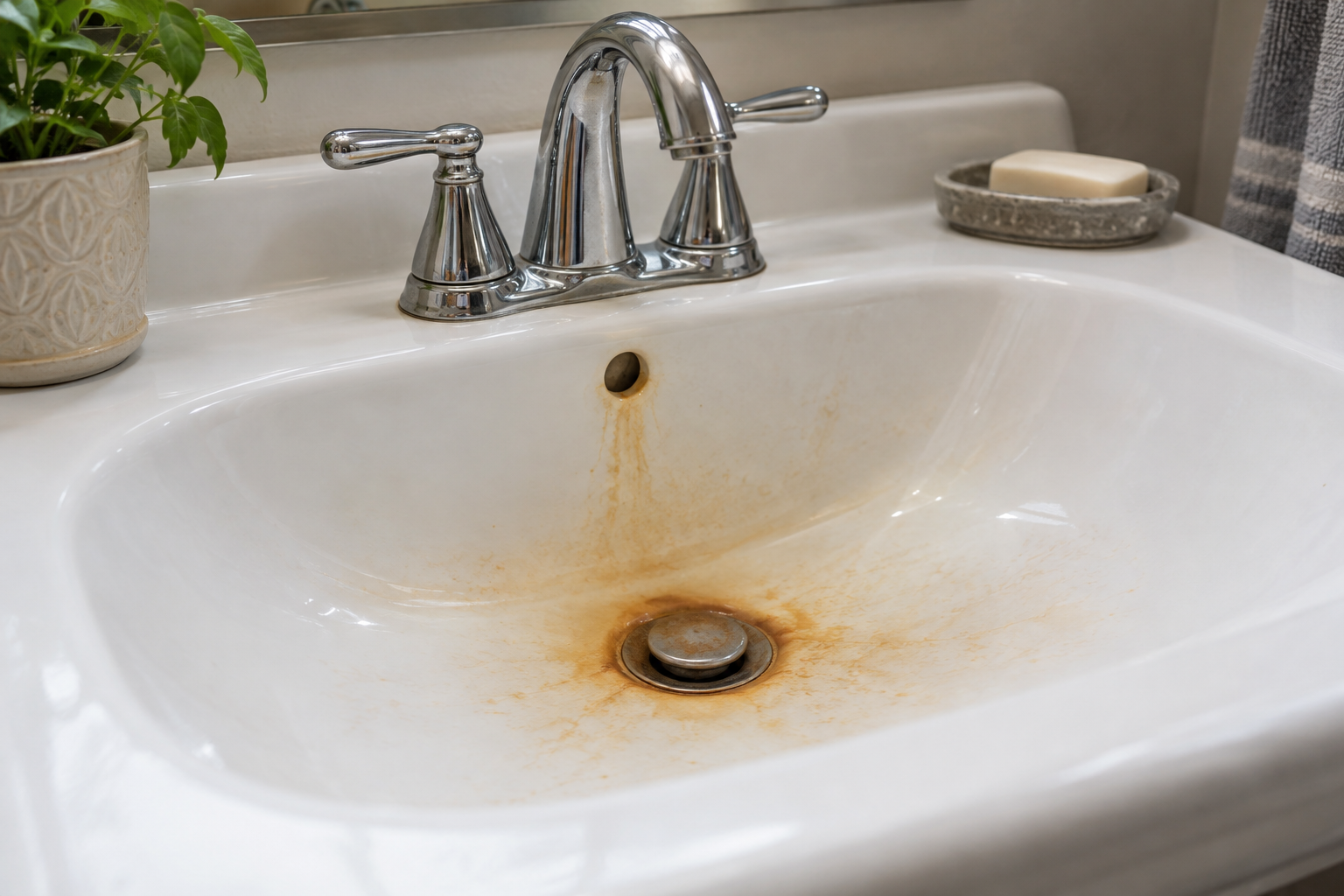
Start with the stain pattern to narrow down the cause
Iron trouble becomes visible where water sits, splashes, heats, or dries. A toilet bowl may develop an orange ring while its tank holds brown sediment. One sink may have a rusty faucet streak while another stays clean because it is wiped more often. White laundry may come out yellowed even though the wash water looked clear. These differences are useful, but none identifies the cause.
Several things can leave similar marks. Iron may be dissolved when water leaves the tap and become visible after contact with air. Particles may already be present in the water. Iron bacteria can produce rust-colored slime. Manganese may add dark brown or black material. Older plumbing and a water heater can contribute scale or corrosion debris. A picture of an orange sink cannot separate those possibilities.
Before cleaning every trace away, write down four parts of the pattern:
- where the stain appears and how it returns after ordinary cleaning,
- whether it follows hot water, cold water, or both,
- whether it is limited to one fixture or appears around the house, and
- whether the residue wipes up as slippery film, loose grit, fine powder, or a mixture.
Use plain descriptions. "Orange film inside the toilet tank and a swampy odor" gives a laboratory more to work with than "the water is rusty." So does "brown grains from the hot side only" or "dark specks caught in every faucet aerator." The pattern helps choose sample locations and questions. The laboratory result and system inspection do the identifying.
Spot what can leave orange or dark residue
Four explanations belong in the conversation when well water leaves orange, brown, reddish, or dark residue. They can overlap. Source water may contain iron while a water heater also holds scale or corrosion debris.
Dissolved iron that oxidizes after leaving the faucet
Water with dissolved iron can look clear as it leaves the faucet. After exposure to air, iron can become visible as reddish-brown color or particles. That can leave a ring in a toilet bowl, a line in a pet-water dish, or a stain where a faucet drips. Clear-looking water at the tap does not rule iron out. If a fresh sample changes as it stands, record the change without treating it as proof of a particular form or concentration.
Iron bacteria
Iron bacteria can produce rust-colored or brown slime in wells and plumbing. A toilet tank is often more revealing than the bowl because the tank stores water and is not scrubbed as often. Look for a slippery coating on the tank walls, floating strands, or soft material around the fill assembly. Similar film may collect in sink drains or other persistently wet places. A swampy, musty, or oily odor may be present. Slime and odor make iron bacteria worth discussing with the laboratory, but appearance and smell alone do not confirm them.
Manganese
Manganese can leave dark brown or black staining and blackish particles. It may show up as a dark line in a sink or tub, powder in a toilet tank, or dark specks mixed with orange residue. Because manganese and iron can occur together, color may not divide them neatly. Tell the laboratory about both the orange and dark material instead of labeling all of it rust.
Plumbing corrosion
Metal released from plumbing can also look orange, brown, or reddish. Aerator screens may catch flakes, and a rarely used tap may release discolored water when first opened. Material limited to the hot side can put the heater or hot-water piping on the inspection list. Blue-green staining raises a different corrosion question involving copper plumbing. Location matters here: one faucet, one plumbing branch, and the entire house do not point to the same place.
Color is the starting description, not the finding. Keep iron, iron bacteria, manganese, and plumbing corrosion separate in your notes so the laboratory or professional can decide which tests and inspections fit the house.
Watch a cleaned fixture to see whether stains return
Choose one sink, tub, or toilet where the mark is easy to see. Clean it the way you normally do, note when you cleaned it, and photograph the same area under similar light when you check again. The point is not to run a timed experiment. You are looking for a repeatable pattern under normal household use.
A toilet gives you two useful surfaces. The bowl shows stains where water stands and flushes. The tank may show settled particles or film. If you open the tank lid, set it down securely and do not reach into moving parts or add cleaners. Record coated walls, loose material on the bottom, and any odor.
At sinks and tubs, notice whether color follows the water path, collects around a drain, or remains after splashes dry. For laundry, record the load type and stains on white fabric. Do not test the theory with valued clothing. Record the following:
- The mark returns with ordinary water use. Note which fixture was used and whether the material appears in the water, settles afterward, or remains only when droplets dry.
- The mark develops where water stands. Toilet waterlines, tank bottoms, drain edges, and a slow faucet drip can make a faint problem easier to see.
- Discoloration appears when a tap is first opened. Record whether it clears with use and whether the same thing happens at another tap. A local pipe or fixture can behave differently from the rest of the house.
- The stain does not match the water path. Residue outside the area reached by water deserves a separate look instead of being counted automatically as a well-water symptom.
A clean, clear glass can help you describe what the water does after drawing, but it is not a substitute for laboratory bottles or collection instructions. Set the glass on a white background and note whether the water begins clear, already contains particles, or develops visible color while it stands. Do not assign a diagnosis or a concentration from the change.
Compare hot and cold water to see where a stain starts
Use the same sink so the fixture and branch plumbing stay constant. Run hot and cold into separate clean, clear containers and label them. Compare color, visible particles, and odor without tasting the water. This household comparison is for your notes. Collect any laboratory samples only where and how the laboratory instructs.
- Hot and cold look alike. A matching pattern keeps shared upstream sources on the list, including the well water, pressure system, main cold-water plumbing, and any whole-house equipment. It does not prove which one is responsible.
- Only the hot side shows color or grit. Put the water heater and hot-water piping on the inspection list. Material can collect in a heater and appear when hot water is used. A plumber can assess the equipment and piping rather than guessing from the stain.
- Only the cold side shows the problem. Compare cold water at other taps. One affected sink can point toward its aerator, supply line, or branch. A similar cold-water pattern around the house moves attention farther upstream.
- The odor changes with temperature. Write down whether it is present at the cold tap, only after heating, or in both. Heat can make an odor easier to notice, and a hot-only odor can shift the inspection toward the heater without proving its cause.
Do not drain, open, or adjust a water heater as part of this observation. Those jobs carry burn, pressure, fuel, and electrical risks and belong under the manufacturer's instructions or with a qualified plumber. For this check, what comes from the faucet is enough.
Compare fixtures to see how widespread the problem is
A stained bathroom sink is easy to blame on the well, but first check whether the same pattern exists elsewhere. Compare a kitchen cold tap, another bathroom, a toilet tank, and a laundry or utility sink if the house has one. Include both frequently used and rarely used fixtures. Write down the location instead of relying on memory.
- One sink or faucet. Check the aerator, local filter, flexible supply line, and visible fixture condition. A local difference makes that fixture and its nearby plumbing the sensible first inspection area.
- One toilet. Compare its tank with another toilet if possible. Usage, cleaning, and fixture parts can differ even when both receive the same water.
- Several fixtures on one branch. A group of affected fixtures can direct a plumber toward their shared piping, a valve, or recent work on that part of the house.
- Fixtures throughout the house. A widespread pattern keeps the source, pressure system, main plumbing, and whole-house treatment in view. Testing raw and treated water may help separate those areas when a laboratory recommends the sample points.
- Laundry as the first obvious sign. Wash water may look clear while pale fabric collects yellow or rusty discoloration. Note whether sinks and toilets also show subtler marks, and save the damaged item or a photograph as part of the record.
A basement tap or outdoor spigot may bypass a softener or filter, but many do not. Trace the plumbing or confirm the layout before calling any tap "raw water." When the layout is unclear, tell the laboratory and treatment professional that the sample point is uncertain. A confident but wrong label can spoil the comparison.
Tell slippery film from loose grit
Texture changes the questions you ask. Use what you can see when residue is in a toilet tank or another area with moving parts. On an accessible sink or tub surface, a plain white paper towel can help show whether the material smears as a soft film or lifts as separate grains. Wash your hands afterward, do not taste the water or residue, and stop handling it if sewage, chemicals, flooding, or illness may be involved.
- Soft or slippery film. Rust-colored or brown slime in toilet tanks, sink drains, or persistently wet plumbing keeps iron bacteria on the list. Note any strands, oily-looking surface film, or swampy, musty, or oily odor. Report the observation without calling it confirmed bacteria.
- Loose grit or flakes. Orange, brown, or dark particles may be oxidized minerals, formation sediment, scale, or corrosion debris. Record the color and where they collect. Material in the hot side, one aerator, and every fixture calls for different follow-up.
- Fine dark powder. Dark brown or black material makes manganese worth raising with the laboratory. Plumbing material can also be dark, so location and testing still matter.
- Film mixed with particles. More than one process can be present. A filter cartridge, toilet tank, or drain may collect several kinds of material, and appearance alone cannot sort the mixture.
Describe odor in the same note as texture and location. "Swampy odor at both cold taps" is more useful than "bad smell." "Odor only from hot water" is useful too. Iron bacteria and sulfur-related conditions may be part of the investigation, but the nose cannot identify them. None of these observations answers whether the water is safe.
Know when to stop and get local help
The household observations above are reasonable for ordinary, steady staining. A few situations change the picture, and when they apply you should stop troubleshooting and switch to a different, known-safe water source while you get local guidance. Those situations include:
- Cloudy, rust-colored water that arrives suddenly after heavy rain or flooding. Water that turns muddy, orange, or brown all at once after a storm can mean surface runoff reached the well. That is not a routine staining observation, and it calls for prompt local testing and guidance rather than a slow household comparison.
- Concurrent changes in pressure or pump behavior. If the colored water shows up together with falling pressure, sputtering air, rapid pump cycling, a pump that runs continuously, or sand, the well, pump, pressure tank, or buried line may be involved. This needs a qualified well or pump professional, not a water chemistry decision.
- Well or plumbing damage is suspected. A damaged cap, cracked casing, flooded well, or recent loss of pressure all change the priorities and may require immediate attention before any staining is considered.
- An official advisory, an emergency, or illness. If your health department issued an advisory, the well was flooded, sewage or chemicals may be involved, or someone may be ill after using the water, stop using that water and contact the appropriate local agency or professional at once.
Do not taste the water to check anything, and do not assume boiling or a household filter fixes a contamination situation. The guide to telling air bubbles from particles in cloudy well water covers sediment observations in more detail. The checklist for a sudden change in well water explains whom to call and what to record under these conditions. They are the exception, not the everyday staining case, so honoring them keeps the rest of this guide safe to follow.
Decide what to test on your water well before buying treatment
Testing comes before treatment, and that is not a slogan; it is the order that prevents wasted money. Once your observations are recorded, the next step is a certified laboratory, not a treatment catalog.
Call a state-certified drinking-water laboratory before you collect anything. Describe the symptoms with the language from this guide: whether stains reappear quickly, whether they follow hot or cold, whether they are local or whole-house, and whether the residue is slime or grit. Also mention when the problem began, whether it is new since well work, flooding, disinfection, or a change in use, and which taps sit before or after your treatment equipment. That detail helps the laboratory choose the analyses that will answer your question.
For orange, brown, or reddish staining, the discussion with the laboratory most often starts around iron and manganese, including separate dissolved and total iron determinations, and pH, along with other tests tied to your local geology and land use. If slime or odor is present, tell the laboratory, because iron bacteria are not the same as an iron concentration result and may require a different kind of investigation. Ask specifically how iron bacteria would be addressed in sampling if the laboratory considers it relevant.
Paired samples are often the most useful. A raw-water sample from a confirmed untreated tap can show what enters from the well, and a treated sample can show what reaches a household tap, so the comparison can reveal whether treatment is removing material, passing it through, or introducing a new effect. Ask the laboratory which sample locations and procedures are required before you collect anything. Do not collect a laboratory sample in a household jar; use the containers and procedure the laboratory specifies.
A single test does not end the story; ask the laboratory when another sample would be useful after weather, repair, disinfection, or a treatment change. Keep results together with sample locations, dates, and observation notes. For a fuller picture, read how to plan certified well-water testing. To sort this symptom alongside other changes, use the private-well problem guides or the guided Well Water Symptom Finder.
Why concentration and chemistry matter before equipment
Treatment performance depends on the actual water conditions, not on the general category "iron filter." The form of iron reported by the laboratory, the amount reported, pH, manganese, and other system conditions can affect which equipment may be suitable. Manganese and iron bacteria can require different treatment approaches, so equipment chosen from an orange stain alone may miss the problem. Take the laboratory report and the plumbing layout to a qualified water-treatment professional before comparing specific products.
Match your observations to the next step
The table below brings the observations together. Choose the row that comes closest to what you saw and follow its suggested next step. The table does not identify a contaminant and does not prescribe treatment; it only helps you decide what to check next.
| What you observe | Best next step |
|---|---|
| Floodwater reached the well, an advisory, sewage or chemicals, a damaged cap or casing, or illness after use | Stop using the water, switch to a known-safe source, and call the health department, environmental agency, or well professional that handles the situation. |
| Cloudy, rust-colored water arrived suddenly after heavy rain or flooding, or comes with falling pressure, sputtering, or rapid pump cycling | Stop the household checks and get local guidance and a qualified well or pump inspection promptly. |
| Clear when first drawn, then develops orange or brown color or particles while standing | Record the pattern and ask a certified laboratory about dissolved and total iron, manganese, pH, and tests recommended for your area. |
| Stains return with ordinary use at fixtures across the house | Contact a certified laboratory about iron, manganese, and locally appropriate analyses, and describe where the pattern appears. |
| Only hot water shows color, grit, or sediment | Compare hot and cold water, then have persistent problems evaluated by a plumber, with the water heater on the list. |
| Only one fixture is stained | Inspect the aerator, local filter, supply line, and branch plumbing on that fixture before blaming the well. |
| Slimy, rust-colored residue with an odor in toilet tanks or drains | Note the slime and odor and ask the laboratory whether iron bacteria or sulfur conditions warrant additional investigation. |
| Dark black or nearly black residue alongside the orange | Raise manganese with the laboratory; manganese is often tested together with iron. |
| Blue-green staining or particles | Ask a professional about copper and plumbing corrosion; this points toward the plumbing, not the source. |
| Orange staining with particles felt as grit or sand | Consider formation sediment, scale, corrosion debris, or oxidized minerals; contact a laboratory and a well professional as the system layout suggests. |
Record everything before you call
Use the same glass, background, lighting, and camera position for any photographs, and include a clock or written time in the frame so you can compare how quickly samples change. In your note, record how fast stains return, whether they follow hot or cold water, which fixtures were affected and how often, whether the residue felt slimy or gritty, and what recent events preceded the change, such as heavy rain, well service, pump replacement, or disinfection. A dated timeline helps a professional choose the right inspections even when the most recent event is not actually the cause.
Do not solve the problem by flushing until it disappears, changing several filters or settings at once, or buying treatment from the symptom. If treatment is eventually considered, use the guide to choosing water treatment from test results only after the laboratory report is in hand. Keep up with private-well inspection and maintenance so a water-quality purchase does not distract from the condition of the well itself.
If rust or black staining is the issue, check your iron and manganese results with the test results checker, and use the water softener size calculator to size a softener for iron and manganese.
Where this guidance comes from
- Minnesota Department of Health. Iron in Well Water
- Minnesota Department of Health. Iron Bacteria in Well Water
- U.S. Environmental Protection Agency. Protect Your Home's Water
- U.S. Environmental Protection Agency. What to Do With Your Private Well After a Flood
- Connecticut Department of Public Health. Iron and Manganese in Private Well Water
- Penn State Extension. Water Well Care and Rehabilitation