
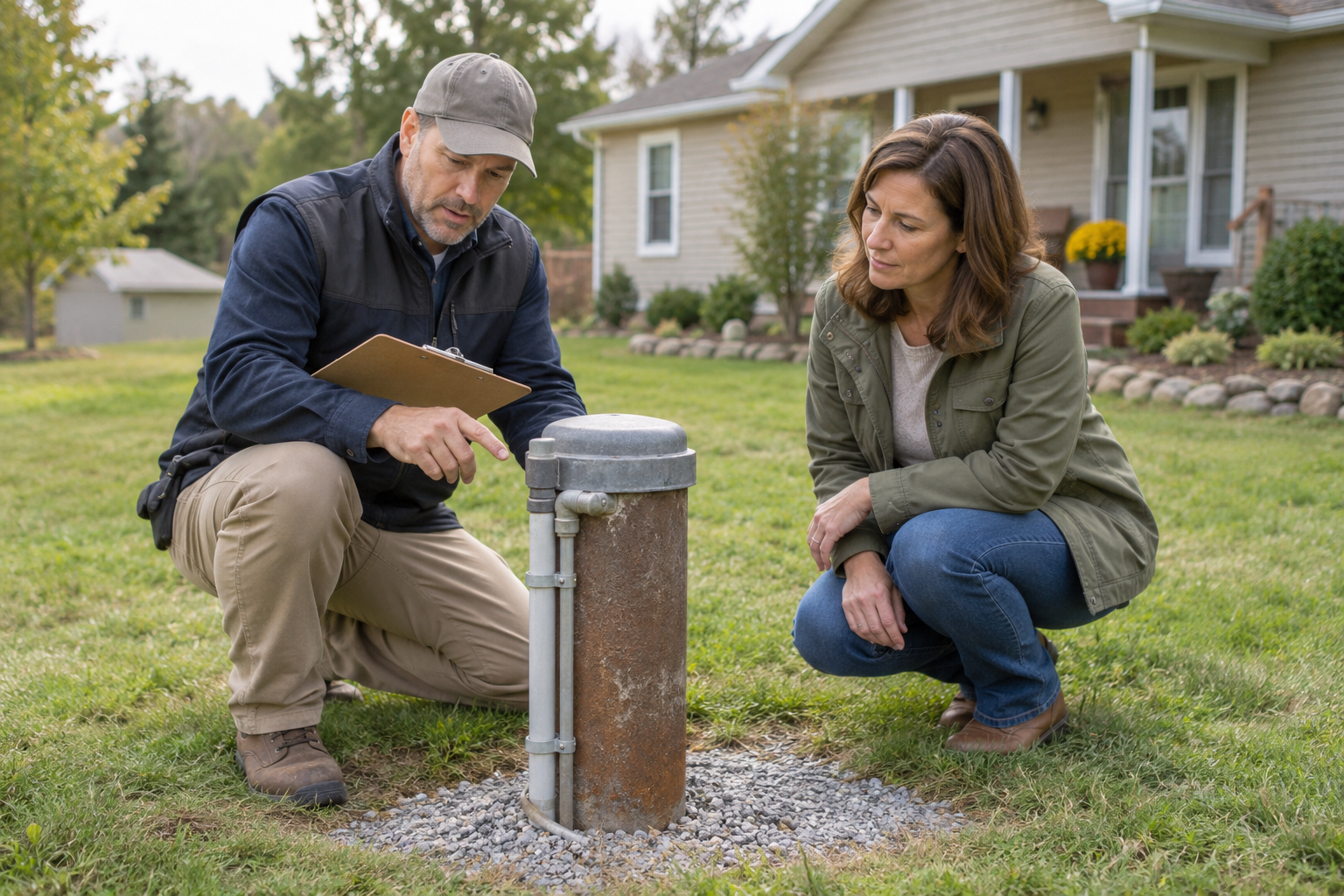
Record what changed before you try anything else
Describe what came out of the tap before naming a cause. “Orange particles settle in a clear glass” gives a laboratory or contractor something useful to work with. “The well is rusty” skips over other possibilities. The same applies to pressure and air: “the kitchen cold tap sputters when the pump starts” is more useful than “air is getting into the well.”
Write down when you first noticed it and whether it happens every time. Was it the morning after heavy rain? Right after the power came back on? After a filter change, plumbing repair, well service, or a day of unusually heavy water use? Photograph visible water in a clean, clear glass against a light background. If the area is safe, photograph the wellhead from the surface, nearby standing water or excavation, and any visible equipment alarm. Do not open a well, pressure vessel, filter housing, or electrical control for a closer look.
What happened just before the change?
Start with the past few days, then look farther back if nothing stands out. A short timeline helps the laboratory, local health office, plumber, or well professional ask better questions. Include:
- heavy rain, flooding, snowmelt, drought, wildfire, ground movement, or a power outage
- a septic backup, manure application, chemical spill, fuel delivery, road salting, or nearby fire response
- excavation, blasting, drilling, construction, utility work, or a new neighboring well
- service to the well, pump, pressure tank, water heater, plumbing, filter, softener, or other treatment equipment
- a filter change, salt refill, empty chemical-feed tank, moved bypass valve, or treatment alarm
- unusually high household water demand, pressure loss, or a well that may have been pumped low
The newest event may be unrelated, so treat it as context rather than proof. Keep receipts, service notes, well records, prior laboratory reports, and treatment manuals with the timeline.
Describe the water in neutral terms
| Question | Details worth recording |
|---|---|
| What changed? | Color, cloudiness, particles, film, foam, odor, taste, pressure, flow, sputtering, staining, or equipment alarm |
| Where does it happen? | One fixture, one branch, hot water, cold water, untreated water, treated water, outside tap, or the whole house |
| When does it happen? | At first draw, after water runs, when the pump starts, during high demand, after rain, or after repair |
| How does a sample behave? | Bubbles rise, particles settle, haze remains, color develops, or a surface film appears |
| What changed nearby? | Flooding, septic trouble, spill, excavation, road work, fire, land disturbance, or neighboring well work |
| What changed in the system? | Pump, tank, heater, plumbing, treatment, bypass position, filter, power, or maintenance |
Sensory clues can guide the next call, but they cannot establish water quality. Some contaminants have no noticeable color, taste, or odor. Other conditions can change appearance or plumbing performance without explaining what is in the water. EPA recommends testing after changes in odor, color, or taste, after well-system repairs, and when nearby conditions change significantly. See EPA guidance for protecting a home's well water.
Make a simple water-path sketch from the well to the taps. Mark the pressure tank, treatment equipment, water heater, and confirmed raw and treated sample points. Keep event notes separate from advice and completed work: the event log records what changed, the call log records who gave instructions, and the work log records inspection findings or repairs. Save laboratory instructions, submission forms, complete reports, and labeled sample locations with the same record.
Label every observation and sample with the exact tap, whether the water was hot or cold, and which equipment came before it. “Basement tap before all treatment” is more useful than “raw sample.” “Kitchen cold after softener and local filter” explains what the result represents. If the pipe route or treatment order is uncertain, record that uncertainty rather than guessing.
If the change comes and goes, keep a short water diary under ordinary household conditions. Note the weather, household demand, pump behavior, pressure changes, treatment alarms, odors, particles, and fixtures affected. Avoid changing filters, bypass positions, treatment settings, or plumbing while you are still documenting the pattern unless the responsible professional directs the work. If an urgent condition develops, stop observing and return to the stop-use guidance.
If a follow-up sample is requested, record why it is needed and what must happen before collection. Keep its bottle labels, instructions, sample point, and submission form with the original report. This prevents a sample collected after flushing, repair, disinfection, or treatment changes from being mistaken for a repeat of the original conditions.
Find out how much of the house is affected
Once the urgent conditions above have been ruled out, a few safe comparisons can tell you whether to start with a faucet, the hot-water system, treatment equipment, household plumbing, or the well system. They still cannot identify a contaminant. Do not make these comparisons during a flood, spill, electrical hazard, or suspected sewage event, and do not taste the water.
One tap or all taps
Check a second cold-water tap in another part of the house. If only the kitchen faucet has black flecks, low flow, or an odd odor, start by telling the plumber or laboratory about that fixture, its aerator, any under-sink filter, the flexible supply line, and the nearby branch pipe. If the same change shows up at several taps, including one away from the first room, the shared plumbing, treatment equipment, pressure system, or well becomes more relevant. This comparison narrows the search but does not prove the source.
Cold water or hot water
At the same fixture, check cold water first and then hot water, using separate clean glasses if you need to describe color or particles. An odor, color, or particle seen only on the hot side makes the water heater or hot-water piping more relevant. If both hot and cold water changed, look farther upstream. A laboratory will often want a cold-water sample for a drinking-water question, but let the laboratory choose the tap and preparation for the question you are trying to answer.
First draw or after the water runs
Record whether the change is there when you first open the tap, clears during ordinary use, or begins only after water has run for a while. A first-draw pattern makes the fixture or water that sat in household plumbing worth discussing. A change that begins during sustained demand makes pump operation, changing water level, disturbed material, pressure equipment, or treatment performance worth discussing. Do not run the water for a long time before a laboratory or agency explains how to collect the sample, especially when a chemical release is possible.
Before treatment or after treatment
If you know the plumbing layout and have safely accessible taps, note whether untreated and treated water look or behave differently. Confirm the path from the well through the pressure tank, filters, softener, ultraviolet unit, water heater, and point-of-use devices. An outdoor faucet is not necessarily untreated.
- A change in untreated and treated water may begin at the well, pressure system, or shared upstream plumbing.
- A change only after treatment may involve a treatment device, downstream plumbing, or the water heater.
- A difference between the kitchen tap and another treated tap may involve a local filter, fixture, or branch line.
Do not operate unfamiliar bypass valves, open pressurized housings, or defeat safety controls. Raw water should not be consumed for comparison. Label every observation and later laboratory sample with the exact location and treatment status.
Check the wellhead from the surface
Only approach the wellhead when the ground and electrical equipment are dry and there is no spill, floodwater, or other hazard. From the surface, look for a loose or missing cap, cracked casing or conduit, damaged vent screen, soil settlement, standing water, vehicle impact, or new drainage toward the well. University of Minnesota Extension notes that cracks, a loose sanitary cap, and a damaged vent screen can provide routes for contamination after flooding. See its well-water flooding guidance.
Ask for testing that fits what happened
There is no single test that covers every sudden water change. The useful list depends on what changed, what happened nearby, local geology and land use, the plumbing and treatment layout, and earlier results. Start with your state's certified drinking-water laboratory list, then call the laboratory before collecting anything. Your county or state health office or local extension office may also know which concerns are common in the area. For a spill or public-health event, call the responsible health or environmental agency first because it may direct the sampling.
Questions to ask the laboratory
- Which analyses fit the event and the observed change?
- Should the plan include untreated water, treated water, a household tap, or more than one location?
- Which tap should be used, and should its aerator or attachment be removed?
- What preparation and flushing instructions apply to each sample?
- Which containers, preservatives, cooling steps, and delivery schedule are required?
- Does recent repair, disinfection, filter service, or flushing affect the timing?
- Should an agency representative, contractor, or trained sampler collect evidence after a spill?
Use the laboratory's containers and instructions. Bacteria, volatile organic compounds, metals, and other analyses can require different bottles and collection methods. A household food jar may make a sample unusable. EPA maintains a directory of state certification programs and certified drinking-water laboratories.
Connect likely tests to the event, not the symptom alone
After flooding, surface-water entry, a loose cap, septic trouble, or well repair, ask the health department or laboratory about microbial testing and other locally relevant analyses. After a fuel, solvent, pesticide, or industrial incident, let the environmental agency or laboratory define the chemical-specific panel. Do not assume that a general household water panel covers the released material.
For a new salty or metallic taste, staining, corrosion, sediment, odor, or cloudiness, describe the pattern and system location rather than requesting one substance by name. The laboratory may ask about pH, dissolved solids, minerals, metals, or other measures, but the suitable list depends on the event and local conditions. A rotten-egg odor, for example, should be reported as hot-only, cold-only, or present on both sides and as occurring before or after treatment. That is more useful than assigning a cause from odor.
Sand, air, low flow, falling pressure, rapid pump cycling, and intermittent particles may require mechanical evaluation as well as water testing. Penn State Extension recommends professional evaluation when well performance changes and notes the value of the original well log and pump information. See Water Well Care and Rehabilitation.
Protect sample quality
Follow the laboratory's directions even when they differ from an online checklist. Do not rinse sterile or preserved bottles. Do not touch the inside of a bottle or cap. Do not collect through a hose, spray head, swivel faucet, or household filter unless the laboratory directs it. Label the bottle immediately with the location, date, collection time, and treatment status. Tell the laboratory about recent chlorination, plumbing work, filter changes, bypass changes, or flushing.
Keep the full report and submission form. A result describes the submitted sample for the analyses listed. It may not represent another tap, another time, untreated water, or a contaminant that was not ordered. Ask the laboratory or health department what the result means for the event and whether follow-up sampling is needed.
Know who to call for help with your water well
Different people answer different parts of a sudden water change. Share the same event log, photographs, well record, treatment layout, repair history, and laboratory reports so that each person starts with consistent information.
- Local or state health department
- Provides location-specific guidance about water use, local contaminants, flooding, suitable tests, and the conditions for returning a well to use.
- State environmental agency or spill program
- Handles fuel, pesticide, solvent, industrial, wildfire, and other environmental releases and may direct sampling or cleanup.
- State-certified drinking-water laboratory
- Selects analytical methods, supplies containers and collection instructions, receives samples, and reports results.
- Qualified well or pump professional
- Inspects the cap, casing, seal, pump, wiring, water level, yield, pressure equipment, and well integrity, and performs authorized repair.
- Licensed plumber
- Traces fixture, branch-line, cross-connection, water-heater, and building-plumbing problems.
- Water-treatment professional
- Checks existing equipment and evaluates treatment only after the water condition, flow, and performance needs are defined.
- Septic professional
- Evaluates a failing or flooded onsite wastewater system and coordinates repair.
Licensing and agency names differ by state. EPA's state private-well program directory is a useful starting point. Use EPA's directory to find your state private-well program. Depending on location, the appropriate health or environmental office, extension service, certified laboratory program, or emergency spill contact may be separate.
Avoid changes that erase useful clues
- Do not buy treatment from a color, odor, or photograph. Similar clues can have different sources. Define the problem and where it enters the system before comparing equipment.
- Do not boil water when chemicals may be involved. Boiling or disinfection does not remove heavy metals, salts, or most other chemicals. Follow agency instructions for the actual event. See EPA emergency drinking-water guidance.
- Do not disinfect the well before getting advice. Disinfection may be part of a professional response to some microbial events, but doing it before inspection or sampling can change the evidence. It does not address chemical contamination.
- Do not treat a home test strip as clearance. A screening tool answers only the limited question it was designed for. It does not replace suitable certified-laboratory analysis or agency guidance.
- Do not assume the kitchen tap represents the well. Water may pass through filters, a softener, a water heater, reverse osmosis, or local plumbing before reaching that tap.
- Do not flush until the clue disappears. Extended flushing can change what a sample represents. Ask the laboratory how to handle first-draw and flushed samples.
- Do not treat one negative result as proof about everything. The result applies to the listed analyses, sample location, and collection time.
- Do not ignore pressure and mechanical changes. Sand, air, low flow, rapid cycling, and intermittent cloudiness may need well, pump, or plumbing evaluation.
Choose your next steps with your notes in hand
- Use the stop-use section first. If flooding, sewage, a chemical release, well damage, an advisory, or possible illness applies, pause household checks and call the right authority or professional.
- Write a neutral description of the change and record when and where it happens.
- List recent weather, outages, nearby work, spills, repairs, and treatment service.
- If conditions are not urgent, compare one tap with others, hot with cold, and untreated with treated water where safe and clearly identified.
- Find the well log, prior laboratory reports, repair records, and treatment manuals.
- Call a certified drinking-water laboratory before collecting a sample. Follow its bottles, locations, preparation, timing, and delivery instructions.
- Arrange qualified inspection for damaged equipment, changing pressure, sand, air, unusual pump operation, or repeated treatment problems.
- Keep restrictions in place until the responsible agency or professional explains the results and the conditions for returning the system to use.
A change that disappears can still matter. Do not return to ordinary use only because the water looks or smells normal again. Keep the event notes, complete reports, and work records with your well file. After repair, disinfection, or treatment work, ask whether follow-up sampling is needed and when it should be collected.
For a nonurgent clue, review common well-water problems, learn how to plan water testing, or use the guided Symptom Finder. Treatment decisions belong after the problem and system requirements are understood.
Where this guidance comes from
- U.S. Environmental Protection Agency. Protect Your Home's Water
- U.S. Environmental Protection Agency. Emergency Disinfection of Drinking Water
- U.S. Environmental Protection Agency. Contact Information for Certification Programs and Certified Laboratories for Drinking Water
- U.S. Environmental Protection Agency. Private Drinking Water Well Programs in Your State
- Centers for Disease Control and Prevention. How to Disinfect Wells After an Emergency
- Centers for Disease Control and Prevention. Guidelines for Testing Well Water
- New York State Department of Health. Restoring and Testing Your Private Well After a Flood
- Minnesota Department of Health. Well Testing, Results, and Options
- University of Minnesota Extension. Test Your Well Water After Flooding
- Penn State Extension. Water Well Care and Rehabilitation