
Well Care · Owning a Well
Old or Unused Wells on Your Property: find them and handle them responsibly
How to recognize an old, abandoned, or unused well on your property, why it matters for safety and groundwater, what to do right away, and how proper decommissioning by a qualified professional works in general.
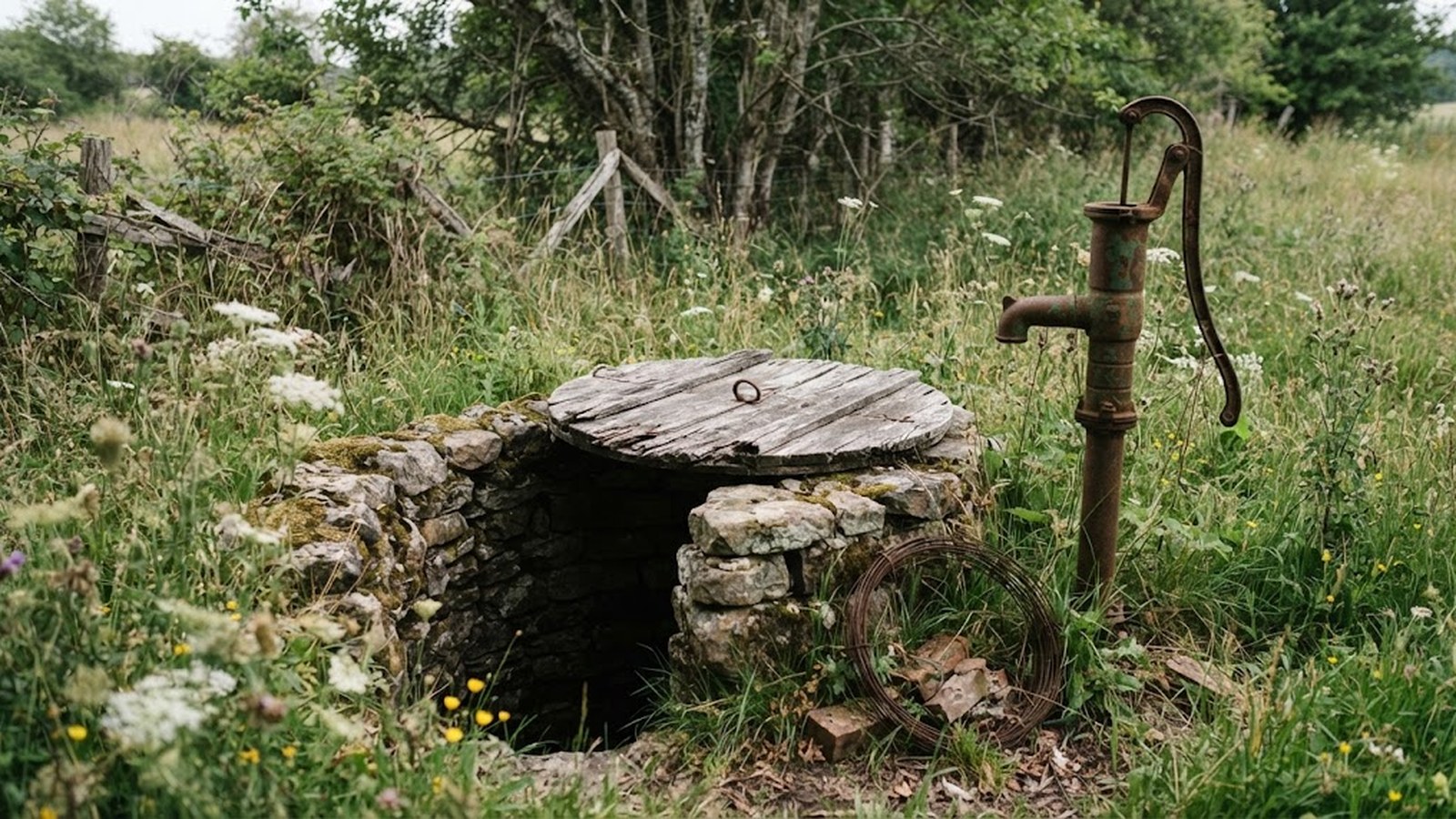
Many rural properties have more than one well. Sometimes it is obvious: an old hand pump by the garden, a stone-lined pit behind the barn, or a capped pipe sticking out of the lawn that nobody uses anymore. Other times it is hidden: a well buried under a porch addition, a pit covered with boards and grass, or a pipe that was cut off below ground when a new well was drilled decades ago.
If you plan to reuse an old well, the shock chlorination calculator helps you disinfect it before using it again.
Old and unused wells are easy to forget, but they matter. An unused well that was never properly closed can be a safety hazard for people and animals, and it can be a direct pathway for contamination to reach groundwater, including the water your current well draws from. This article explains how to recognize an old well, why it matters, what to do right away if you find one, and how the process of properly closing it generally works.
The actual work of closing a well, often called decommissioning, plugging, abandonment, or filling and sealing, is usually regulated and is typically done by a licensed well contractor or other qualified professional following state or local rules. This article is about understanding the issue and knowing what to ask for.
Find out why your property may have wells you never knew about
Properties pick up extra wells for several ordinary reasons. When a well fails, gets contaminated, or cannot keep up, a new one is often drilled nearby and the old one is left in place. Farms and rural properties may have had several homes, barns, and outbuildings over the years, each with its own water source. Before modern drilling was common, many wells were dug by hand or driven, so older ones are often wide and shallow. Irrigation wells, livestock wells, and test wells may have been drilled and later abandoned, and when a neighborhood was connected to public water, some homeowners simply stopped using their wells without closing them.
Many of these wells were never properly sealed, because the rules either did not exist yet or were not followed.
See what an unused well can put at risk
Protect people and animals from falls and bad air
Large-diameter dug wells and well pits can be dangerous. A person, child, or animal can fall in, especially if the covering is rotten, loose, or hidden by vegetation. Old covers made of wood, sheet metal, or concrete slabs can deteriorate over time. Even when a well is not deep, falling into it can cause serious injury, and the air in pits and old wells can sometimes be unsafe.
Keep surface contamination out of your groundwater
An open, damaged, or poorly sealed well can let surface water, runoff, animals, debris, and contaminants go directly into the ground, bypassing the natural filtering that soil provides. Some old wells were even used for disposal of waste or trash, which can make them a serious concern.
Because groundwater is connected, contamination entering through an old well could potentially affect other wells nearby, including your own active well and your neighbors' wells.
Stop poor water in one layer from reaching another
Some wells pass through more than one water-bearing layer. When a well is unused and unsealed, it can allow water to move between those layers. If one layer has poorer quality water, it can affect another.
Check what the law expects of you as the owner
Many states and localities have rules requiring unused wells to be properly closed or maintained in a specific way. Rules may also come into play when a property is sold. Your local health department or state well program can tell you what applies. Our Buying or Selling page explains how to find local offices.
Spot an old well on your land and in your records
Old wells take many forms. Here are common signs.
Look for structures that mark a well
The easiest clue is a hand pump, often cast iron, standing alone in a yard, garden, or field. A pipe or casing sticking out of the ground, capped or open and not connected to anything, is another. Also watch for a circular or square stone, brick, or concrete ring at ground level, a small concrete slab with a pipe or a cover in the middle, or a small pit or depression with a lid or boards over it. A small shed or well house that no longer has a purpose and an old windmill tower or its foundation can point to a well as well.
Read the ground for hidden wells
- A small sunken area that stays wet or collects water
- A circle of different vegetation in a lawn or field
- Old foundations of houses, barns, or outbuildings, which often had wells nearby
- Old pipes coming out of a basement wall or crawlspace that lead nowhere
Check the basement and floors for a well inside the house
- An old pipe through the basement wall or floor that is capped or disconnected
- A pit inside a basement or under a floor, sometimes found in very old houses
- An old pump or tank sitting unused in a corner
Use records and memory to confirm what you suspect
Well construction records filed with a state agency may show more than one well on the property, and old deeds, surveys, or plat maps may mark wells. Previous owners or neighbors may remember where old wells were, and home inspection reports from past sales may mention them. Old aerial photographs, sometimes available from state or county sources, can show structures that no longer exist.
Secure a suspected old well safely the day you find it
If you discover what might be an old well, safety comes first.
- Do not enter it or lean over it. Old wells and pits can have unstable edges, rotten covers, and unsafe air.
- Keep people and animals away. Rope it off, put a sturdy temporary barrier around it, or place a secure, heavy cover over it if you can do so safely without standing on unstable ground.
- Do not drop anything into it. Resist the urge to throw rocks, dirt, trash, or debris into an old well to fill it. Improper filling can make later sealing more difficult and can introduce contaminants.
- Do not pour anything into it. Never use an old well to dispose of chemicals, oil, wastewater, or anything else.
- Take photos from a safe distance, and note the location.
- Contact your local health department or state well program to learn what rules apply and how to proceed.
- Contact a licensed well contractor who does well decommissioning work in your area.
If the well is inside a building or under a structure, the same principles apply. Keep it secure and get professional advice.
Weigh closing an old well against keeping it
Not every unused well has to be sealed right away. In some cases, an old well might be kept for a purpose, such as irrigation, livestock water, or as a monitoring well, if it is in good condition and meets local requirements. Some rules allow a well to be kept inactive for a certain period if it is properly capped and maintained.
On the other hand, a well that is damaged, poorly constructed, contaminated, or has no future use is usually a candidate for proper closure.
It helps to raise a handful of questions with a well professional and your local health department. Ask whether the well is in good condition or deteriorating, and whether it was built to a standard that protects groundwater. Ask if there is any reason to keep it, such as irrigation or livestock use, and what local rules require for unused wells. You will also want to know whether it could affect your active well or your neighbors' wells, and whether there is any sign that it was used for waste disposal.
Learn the steps a contractor follows to close a well
The specific methods for closing a well depend on the type of well, its depth and construction, local geology, and state or local rules. A licensed well contractor or qualified professional will know the requirements in your area. In general terms, the process often includes steps like these:
Evaluation. The professional examines the well, measures its depth and water level if possible, and checks for debris, equipment, or obstructions.
Removing equipment and debris. Pumps, pipes, wiring, and debris are typically removed so the well can be properly filled. Old trash or materials that were dumped into the well may need to be taken out.
Disinfection. Some procedures include disinfecting the well before sealing.
Filling and sealing. The well is filled with appropriate sealing materials, which are chosen to prevent water from moving through the well. The type of material and how it is placed are specified by rules and good practice. Simply dumping soil or gravel in is generally not considered proper sealing.
Finishing the surface. The top of the well may be cut off below ground and covered, and the surface restored.
Documentation. In many areas, the contractor files a report with the state or local agency documenting that the well was properly closed. Keep a copy for your records.
Some states have programs that help with the cost of sealing unused wells, particularly in certain situations. Your local health department or state well program can tell you whether any assistance is available.
Prepare for sealing day so the work goes smoothly
For most homeowners, the day the old well is sealed is fairly uneventful. The contractor arrives with a truck and equipment sized for the job, which may be smaller than a full drilling rig. They may need to clear vegetation or remove an old cover to reach the well. They will likely remove any old pump, pipe, or debris, and then place sealing materials. Depending on the well, the work may take a few hours or longer.
A few things help the day go smoothly. Clear a path for the contractor's vehicle and equipment, and keep children and pets indoors or well away from the work area. Point out your active well, septic system, and any buried lines so they can be avoided. Ask the contractor to explain what they found, especially if anything unusual was removed from the well, and ask for photos of the process if you want them for your records. Before they leave, confirm when the documentation will be filed and when you will receive your copy.
Understand the extra care dug wells and cisterns need
Large-diameter dug wells, often lined with stone or brick, are common on older properties. Because of their size and shallow depth, they can present both safety and contamination concerns. Closing them often involves different methods than for a narrow drilled well, and may require removing the upper lining. Again, a qualified professional and your local rules will guide the process.
Cisterns, which store water rather than draw it from the ground, are a related but different case. Old cisterns can also be safety hazards and may need to be properly closed or maintained. Ask your local health department for guidance.
Check for old wells before you buy or sell a home
If you are buying a home, ask the seller whether there are any other wells, active or unused, on the property. Our article on questions to ask the seller includes this. During your showing, look for the signs described above. Our article on touring a home with a well explains what to look for.
If you are selling, check your records and property for old wells. Some areas require disclosure of unused wells or require them to be sealed before or at sale. Even where it is not required, documented proper closure can reassure buyers. Our Buying or Selling page discusses local requirements.
Avoid building over a hidden old well
If you are building on land that had a previous home or farm, old wells may be hidden. During site work, excavators sometimes uncover old wells, cisterns, or pits. If that happens, stop work in that area, keep it secure, and contact a well professional and your local health department. Building over an old well without addressing it can create problems later.
Also note that an old well on the property may affect where a new well or septic system can go, since some rules include setback distances from unsealed wells. Our article on choosing where to put a new well discusses siting.
Shield your active well while you decide on the old one
While you are working on a plan for an old well, protect your active well:
- Keep the old well securely covered to prevent surface water, animals, and debris from entering.
- Keep chemicals, fuel, and waste away from the old well, just as you would with your active well.
- Divert surface runoff away from the old well.
- Test your active well with a certified laboratory on your regular schedule, and consider testing if you have concerns about the old well's influence. Our annual well testing guide explains what to include.
Keep a useful old well safe and sanitary
Sometimes an old well has a real use, like watering a garden or supplying a barn, and a professional and your local health department agree it can be kept. In that case, treat it as an active well, not a leftover.
Start by having it evaluated. A well professional can look at its construction and condition and tell you whether improvements are needed, such as extending the casing above ground, replacing the cap, or improving the seal. An unused or seldom-used well should still have a secure, sanitary cap, and the area around it deserves the same protective habits you use for your main well. Our article on everyday habits that protect your well applies here too.
If an old well connects to the same plumbing as your main well, or if hoses from it run into troughs or ponds, ask a professional about backflow protection. Test the water before using it for anything that involves people, pets, or food, and on a regular schedule if you continue to use it. Keep records of its condition, use, and testing, and revisit the decision periodically. If its use ends or its condition declines, plan to have it properly closed.
Keep the look of an old pump or well ring without the hazard
Old hand pumps, stone well rings, and windmills can be charming reminders of a property's past, and many owners want to keep them. It is often possible to keep the look while removing the risk. For example, a well can sometimes be properly sealed underground while a hand pump or decorative ring is left on the surface as a landscape feature. Ask your well contractor whether this is possible for your situation and whether local rules allow it. If you keep a decorative feature, make sure no one mistakes it for a working water source, especially children or guests.
Talk with neighbors about an old well near the property line
Old wells are not always confined to one property. Farms were divided, lot lines shifted, and old homesteads may sit near boundaries. If you find an old well near a property line, it is worth a friendly conversation with the neighbor. They may know its history, and they have a stake in groundwater safety too. If neighbors have also found old wells, sharing contractor recommendations and information about any local assistance programs can help everyone.
Follow these steps from discovery to a documented fix
If you have found an old well, here is a simple sequence to follow:
- Secure it so no one can fall in or drop things into it
- Document it with photos, location notes, and anything you know about its history
- Check your records and ask previous owners or neighbors what they know
- Contact your local health department or state well program to learn the rules
- Get an evaluation and a quote from a licensed well contractor
- Decide, with professional advice, whether to seal it or keep it as a maintained well
- Have the work done and get documentation
- Test your active well if there is any concern about the old well's influence
- File all records in your well binder
Correct the old-well assumptions that leave hazards in place
"If we filled it with dirt years ago, it is sealed." Filling a well with soil, rocks, or debris is generally not considered proper sealing, and it may not prevent water from moving through it.
"It is too shallow to matter." Shallow wells can still act as pathways to groundwater, and they can be serious fall hazards.
"It is on the edge of the property, far from our house." Distance helps, but an unsealed well can still be a safety hazard and may affect groundwater that others use.
"The old well is fine for watering the garden." It might be, but only if it is in good condition, protected, and meets local rules. Old wells can also be contaminated. Test before using water from an old well for anything that touches food or people.
"It is not my problem, it was there before I bought the house." In many places, responsibility for an unused well passes to the current owner.
Ask a contractor these questions before hiring for well closure
- Are you licensed or certified for well decommissioning in this state?
- What does the process involve for this type of well?
- What materials will you use to seal it?
- Will you remove the pump, pipes, and debris?
- Will you file the required report with the state or local agency?
- Will I receive a copy of the documentation?
- What will the surface look like when you are done?
- Is there any cost-share or assistance program available?
- How long will the work take, and what access will your equipment need?
Record what you find and do for your well binder
Add any information about old wells to your well records binder. That means the location, with photos and a sketch, and what you know about its history. It also means any evaluations or tests, decommissioning reports and receipts, and correspondence with the health department or state agency.
These records are useful for you and for future owners, and they show that the property's water resources have been handled responsibly.
Quick answers to common questions
Can I seal an old well myself?
In many states, well decommissioning must be done by a licensed contractor following specific rules, and a report must be filed. Check with your local health department before doing anything.
How do I know if an old well was already sealed?
Look for a decommissioning report in your records or with the state agency. If there is no record, a well professional can evaluate it.
Is an old hand pump in the yard a working well?
Sometimes it is only decorative, and sometimes it still connects to an old well below. Treat it as a possible well until someone qualified confirms otherwise.
Secure it, call the professionals, and close it properly
Old and unused wells are common on rural properties, and they are easy to overlook. An unsealed well can be a fall hazard and a direct pathway for contamination into groundwater that you and your neighbors depend on. If you find one, keep people and animals away, do not fill it with debris or use it for disposal, and contact your local health department and a licensed well contractor.
In many cases, proper decommissioning by a qualified professional, following state and local rules, is the right solution. It protects your family, your active well, and the groundwater around you. And it is one more way to take care of the water beneath your land, with evidence and good practice guiding the way.