
Buying or Selling · Buying a Home With a Well
Touring a Home With Well Water: What to Look At During a Showing
A room-by-room, yard-by-yard guide to what you can notice about a private well during a home showing, before you pay for inspections or testing.
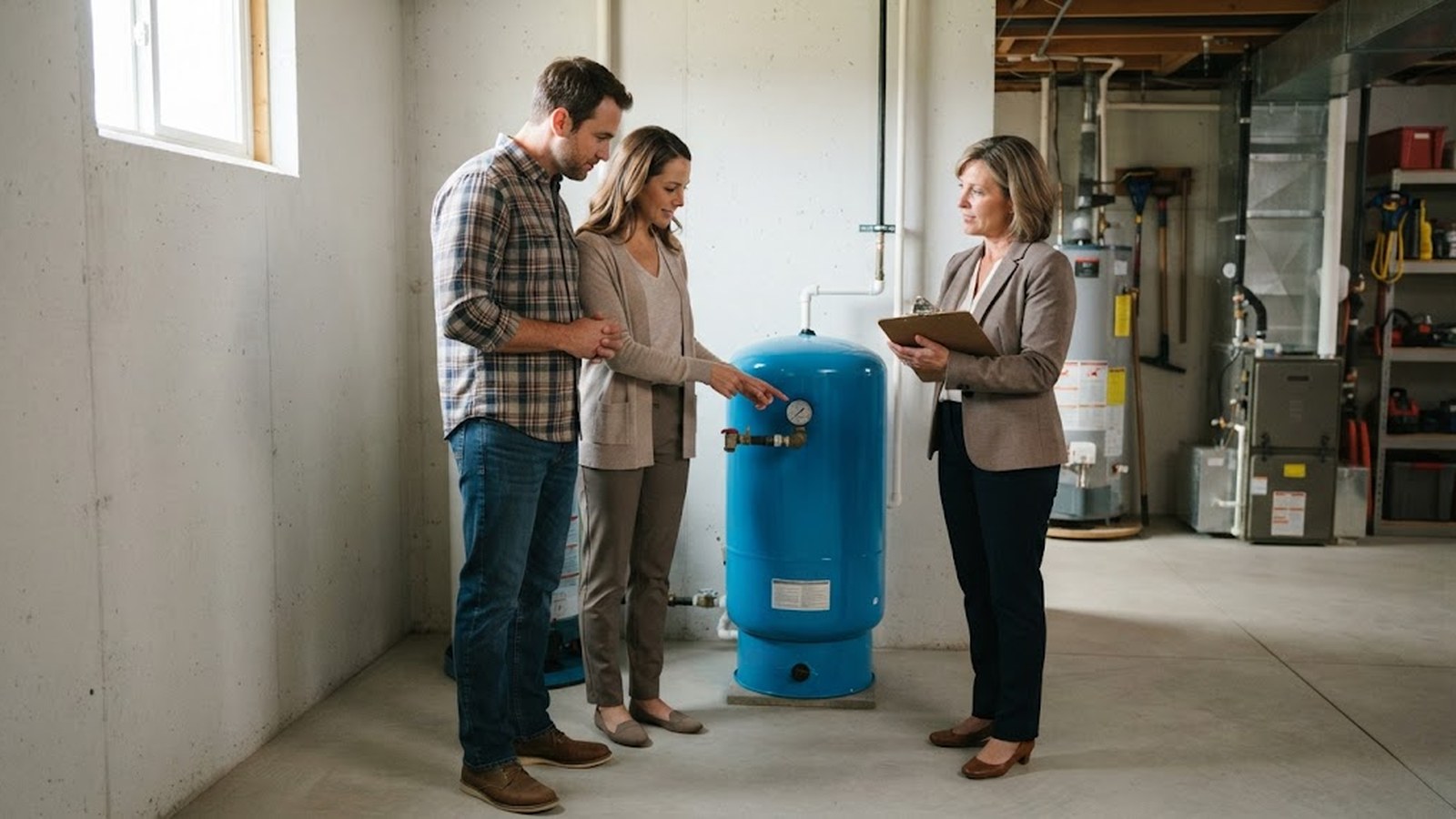
Most people walk into a home showing looking at kitchens, closets, and the view from the back deck. If the house is on a private well, there is a second house hiding in plain sight: the water system. It runs from somewhere in the yard, through a buried line, into a basement, crawlspace, garage, or utility closet, and out to every faucet. Nobody is going to walk you through it unless you ask, and most listing descriptions give it one line at best ("private well") or nothing at all.
The good news is that you do not need special tools or training to learn a lot during a showing. You need to know where to look, what questions to hold in your head, and what is simply worth writing down so the right professional can follow up later. This guide is about that first look. It is not a replacement for a well inspection or a laboratory water test. It is the step before those, the one that helps you decide whether a property deserves an offer and what you want checked if it does.
Use the showing to collect notes you will not get later
A showing is usually the only time before an offer that you get to stand in the house with no one rushing you. Once you are under contract, the clock starts on inspection periods, and everything gets compressed into a few busy days. If you already have notes from the showing, you walk into that period knowing what to ask for.
It also helps you compare houses. When you are looking at three or four rural properties in one weekend, they blur together. One had a newer-looking pressure tank. One had a well cap right next to the driveway. One had orange stains in every sink. Writing these things down in the moment turns vague impressions into a real comparison.
Finally, the showing is a chance to notice what the seller has or has not taken care of. A well system that is clean, labeled, accessible, and accompanied by paperwork tells you something about how the property has been treated. A system that is buried under boxes, hidden behind a finished wall, or impossible to find tells you something too.
Prepare for ten minutes so the showing tells you more
You can make the showing much more useful with ten minutes of preparation.
Read the listing closely. Look for any mention of the well, water treatment, a softener, a filter, "recently updated," or "sold as-is." Note whether the listing mentions a septic system too, since most homes on wells also have one.
Look at the property from above. Satellite views on free mapping sites can show you roughly where the house, driveway, outbuildings, and any obvious septic field sit. Sometimes you can even spot a well cap as a small circle in the lawn. This helps you know where to wander once you are there.
Ask the listing agent to have documents available. It costs nothing to ask. Request any well construction record, past water test results, and receipts for pump or treatment work. Many sellers will not have them handy, but some will, and asking early signals that you are a serious buyer who pays attention.
Bring a simple kit. A phone for photos, a small flashlight, and a notepad or notes app are enough. A clear drinking glass or cup is useful too, for looking at water from a faucet. You are not testing anything; you are just observing.
Locate the well before you step inside
The first thing to do is locate the well itself. On many properties this is easy: a pipe or casing sticks up out of the ground somewhere in the yard, topped with a cap. On others, it takes some searching, or the well is in a pit, a small shed, or even under a porch.
Start with the spots wells are most often found. Many sit within sight of the house, often in the front or side yard, or near the point where the water line would enter the basement or crawlspace. Some are inside a small "well house" or pump house. On older properties, look for a low concrete or block pit with a lid. On farm properties, check near an old outbuilding, garden, or barn.
If you cannot find it, ask the agent or seller. If nobody knows where the well is, write that down. It is not necessarily a deal-breaker, but a well that no one can locate is a well no one has been maintaining.
What to notice at the wellhead
Once you find it, look without touching or opening anything. You are a guest on someone else's property, and the well cap is part of what keeps the water protected.
Height above ground. A casing that sticks up above the ground, rather than ending flush with the soil or below it, is generally what you want to see. A well that ends at or below ground level can let surface water run toward it.
The cap. Does it look intact and firmly seated? Is it cracked, loose, missing bolts, or held on with tape or a rock? Is there a gap where insects or small animals could get in?
The ground around it. Does the soil slope away from the casing, or does water look like it would collect around it after rain? Is there a sunken area, a puddle, or signs of washing?
What is nearby. Note anything close to the well: a driveway where cars park, a dog run, a garden bed, a fuel tank, a burn barrel, a chemical shed, livestock areas, or the septic tank and drainfield. You are not measuring distances; you are just noticing whether anything that could make a mess sits close.
Access. Could a service truck get to it if the pump ever needed to be pulled? Is it under a deck, in the middle of a flower bed, or behind a fence? Access matters when repair day comes.
Take a photo of the wellhead from a few feet away and one close-up of the cap. You will be glad you did when you are comparing properties later.
Walk the yard to see where runoff, septic, and old wells sit
After the wellhead, take a slow lap of the property. You are looking for anything that affects the water system or the area around it.
Look for the septic system. Watch for green or soggy patches, lids or risers in the lawn, or vent pipes. You will want to know roughly where the septic system is relative to the well. Our separate guide on living with both a well and septic system goes into this in more depth.
Look at drainage. Where does roof water go? Where does the driveway drain? Are there low spots that hold water? A property where runoff heads toward the well is worth noting.
Look for old structures. An old hand pump, a stone-lined pit, a concrete slab with a pipe sticking out, or a buried cistern lid can mean there is an old well on the property that is no longer used. Unused wells are worth asking about, because they can be a safety and water-quality concern if they were never properly closed. We cover this in our article on old or unused wells.
Look at outbuildings. Barns, sheds, and garages sometimes have their own water lines, frost-free hydrants, or even their own wells. Note any outdoor faucets or hydrants you see.
Look at the neighbors from a distance. You can often see whether nearby homes are also rural and likely on wells, or whether the area is transitioning. You cannot assess their wells, of course, but it is useful context.
Follow the water line inside to see how the system is set up
Now head inside and find where the water comes in. This is usually in the basement, a crawlspace access, a utility room, or a garage. Here is where most of the visible equipment lives.
The pressure tank
Most modern well systems have a pressure tank, usually a tall cylinder in blue, gray, white, or tan. Older systems may have a large horizontal galvanized tank. The tank stores a little water under pressure so the pump does not have to switch on every time someone opens a faucet.
Things worth noting:
- The approximate size (small, medium, large relative to the room)
- Any rust, bulging, dents, or dampness around the base
- A date sticker or label, if visible without moving anything
- Whether the area around it is dry
Our article on pressure tanks explains what they do in detail, but for a showing, the goal is simply to notice condition.
The pressure gauge and switch
Near the tank you will usually see a small round gauge and a small gray box, often mounted on the pipe. The box is the pressure switch that tells the pump when to run. You do not need to open it, and you should not. Just look at the gauge. It shows the current water pressure. If someone runs water elsewhere in the house, you can watch the needle drop and then climb when the pump kicks on.
This is one of the few things you can actually see working during a showing. If the agent or seller is comfortable with it, run a faucet for a minute and watch the gauge. Note whether the pump seems to start and stop very frequently (every few seconds), which can point to a tank issue a professional should look at.
Treatment equipment
Many homes on wells have some kind of water treatment, and each type looks different. Cartridge filters sit in clear or opaque housings on the water line, often with visible sediment inside. A water softener is usually a tall tank beside a shorter salt tank. Other tanks may be iron filters, neutralizers, or specialty systems. A UV system is a long metal tube, usually mounted on a wall, with a power cord and sometimes an indicator light. Under the kitchen sink, a reverse osmosis unit often has its own small faucet.
Treatment equipment is not a warning sign on its own. It is often a sign that someone tested, found something, and dealt with it. But it raises an obvious question: what was it installed to treat? Write down every piece of equipment you see and plan to ask about it. The existence of treatment makes past water test results even more valuable.
Also notice condition. Is the salt tank full or empty? Are filter housings filthy? Is there a UV system with its light off or its plug disconnected? Equipment that has been ignored may not be doing its job, which matters for how you interpret any water test taken at a faucet.
Plumbing and wiring around the system
Without touching anything, look at the pipes, fittings, and valves for leaks or drips, and at the floor or walls nearby for water stains. Green or white crust on fittings is corrosion. Mixed pipe materials can suggest patchwork repairs. Also watch for messy or improvised wiring, extension cords, or loose connections near the pump controls, since water and electricity together are a safety matter as well as a repair cost.
Anything electrical that looks improvised is worth pointing out to your home inspector.
Read stains and fixtures for clues about your water
Water leaves clues. During the showing, look at sinks, tubs, toilets, showers, and appliances.
Stains. Orange, red, or brown stains often lead people to our iron staining guide. Black or dark gray stains, blue-green stains, or white crust each point in a different direction. On your site visit, you are just noting colors and where they appear, not diagnosing anything.
Toilet tanks. If the seller allows, lifting the toilet tank lid is a common inspection move. The inside of a tank shows what the water has been doing for years, without any recent cleaning. Look for sediment in the bottom, staining, or slimy growth.
Water heater. Note its age if a label is visible, and whether there is any rust or dampness at the base. Well water issues often show up at the water heater first.
Showerheads and faucet aerators. Heavy white crust or grit on these can suggest hard water or sediment.
Freshly cleaned everything. Sellers clean before showings, so a spotless bathroom tells you less than you might think. Look in less obvious places: behind the toilet base, the laundry sink, a basement utility tub, the dishwasher interior.
Running the water
If it is acceptable to the agent, run a few faucets. Use your clear glass. Check whether the water comes out clear or cloudy, colored, or with particles. If it is cloudy, see whether the cloudiness clears from the bottom up within a minute (often air) or stays put. Smell for any odor right at the tap, compare hot and cold, and notice whether the pressure feels steady or surges and fades.
Do not drink it just because it looks fine. Most of the contaminants that matter for health have no color, taste, or smell. What you are doing is gathering observations to discuss later.
Ask the right well questions while you are standing there
Showings are a natural time to ask quick questions. The listing agent may not know the answers, but the questions themselves are useful, and anything they do know is worth hearing. Keep a few in your head. Ask when the water was last tested and whether you can see the results, and what the treatment equipment is for and when it was last serviced. Find out whether the pump or pressure tank has ever been replaced, and whether the house has ever run out of water or lost pressure. Ask if there is a well construction record, whether any other wells, old or active, are on the property, and who services the well and treatment equipment.
We have a full article on questions to ask the seller about the well that goes much deeper, including how to ask for answers in writing.
Know which warning signs to flag for your inspection
None of the following means you should walk away. They mean you should make sure your inspection and testing plans cover them.
Some signs involve the wellhead itself: you could not find the well at all, the cap is damaged, missing, or at or below ground level, water appears to pool or drain toward the well, or something messy such as fuel storage, livestock pens, or a burn pile sits nearby. Others involve the equipment: the pressure tank is rusted or leaking, the pump cycles very frequently, or there is significant treatment equipment but no test results or service records. Others show up in the house, such as staining in many fixtures or water with a noticeable odor, color, or particles. Finally, watch for evidence of an old or abandoned well, or a seller who calls the well "never had a problem" but has no records at all.
Write each one down with a photo. These notes become your checklist for the inspection period.
Understand what a showing cannot tell you about safety or supply
It is easy to walk away from a tidy basement with a shiny tank and feel reassured. It is worth being clear about what you cannot learn from looking.
You cannot see water safety. Bacteria, nitrate, arsenic, and many other things that matter for health are invisible. Only a laboratory test from a certified lab can tell you what is in the water. Our testing guide and our article on annual well testing explain how that works.
You cannot see how much water the well produces. A well can deliver perfect pressure for a ten-minute showing and still struggle when a family of five is doing laundry, showers, and dishes on the same morning. Our article on well yield and flow tests explains how that question gets answered.
You cannot see what is underground. The well's depth, the condition of the casing below the surface, the pump, and the buried line to the house are all hidden. Records and a qualified well professional fill those gaps.
You cannot see the future. A pressure tank that looks fine today may be near the end of its life. Knowing the age of major components helps you budget, but it does not predict exactly when they will need attention.
Turn your notes into a testing and inspection plan
After the showing, spend a few minutes organizing what you saw. A simple structure works well:
Location and wellhead: where it is, photos, condition of cap and casing, what is nearby.
Equipment: pressure tank, switch and gauge, treatment equipment, condition of each, any labels or dates.
Water observations: stains, odor, clarity, pressure behavior.
Property concerns: drainage, septic location, old wells, outbuildings.
Open questions: everything you want to ask the seller or check during inspection.
If you move forward with an offer, this list becomes the basis for what you ask your agent to request: documents from the seller, a water test from a certified laboratory, a well inspection or flow test by a qualified well professional, and anything specific you noticed. Our Buying or Selling section covers records, local requirements, and how to choose a contractor or lab, and it is the natural next stop.
Compare homes side by side so a clean kitchen does not hide a neglected well
If you are looking at several homes on wells, a side-by-side comparison helps a great deal. You might score each property on a few simple points. Could you find the well easily, and did the wellhead look protected and in decent condition? Did the equipment look cared for, and were there documents? Were there obvious water clues like staining or odor, or concerns around the well, like drainage or nearby hazards?
This is not a formal rating system. It is a way of putting your observations on the same page so a clean kitchen does not outshine a neglected well in your memory.
Respect the seller's home while you look at the well
It is someone else's home, and most sellers are happy to have buyers who care about the water system, as long as you are respectful.
Ask before lifting toilet tank lids or running water for more than a moment. Do not open the well cap, the pressure switch cover, or any electrical box, and do not adjust valves, settings, or treatment equipment. Those parts protect the water and the wiring, and a stranger's change can cause a problem the seller will never trace. Do not take water samples without permission; a proper lab sample needs proper collection anyway. Keep your questions friendly and practical, not accusatory.
If you need access to something you cannot see, ask your agent to arrange it with the seller rather than moving things yourself.
Quick answers to common showing questions
Can I ask to see the well during a showing?
Yes. Ask your agent to request it. Most sellers are fine with buyers looking at the wellhead, pressure tank, and treatment equipment, as long as nothing is opened or adjusted.
Should I drink the water during a showing?
It is best not to rely on a taste. Many things that matter for health cannot be seen, smelled, or tasted. A certified laboratory test answers that question.
Is treatment equipment a bad sign?
Not by itself. It often means someone tested and addressed a problem. Ask what it treats and ask to see the test that led to it.
Take your notes to a lab test and a well professional
A home showing will not tell you whether a well is safe or reliable. What it will do is show you where the well is, how the system is set up, what condition things appear to be in, and what questions remain. That is exactly what you need to decide whether a property is worth an offer and to plan the testing and inspections that come next.
Walk the yard, follow the water line, look at the fixtures, write down what you see, and ask simple questions. Then let a certified laboratory and a qualified well professional answer the questions your eyes cannot. Test first, treat second, and gather evidence before you make decisions, starting with the very first time you walk through the door.