
Buying or Selling · Buying a Home With a Well
Well Yield and Flow Tests: Will the Well Keep Up With Your Household?
A plain-language guide to well yield, flow tests, and water quantity for buyers and owners, including what the terms mean, how tests work in general, and how to think about your household's needs.
Most conversations about well water focus on quality: is it safe, does it smell, does it stain? Quantity gets less attention until the day the faucet sputters in the middle of a shower. For a homeowner on a private well, the amount of water the well can reliably provide is just as important as what is in it. And for a buyer, it is one of the hardest things to judge from a showing.
This guide explains well yield in everyday terms: what it is, why it varies, how flow tests work at a general level, what the results can and cannot tell you, and how to think about whether a well is a good match for your household. It is not a technical manual. The actual testing is done by well professionals and inspectors using methods that vary by region. The goal here is to help you understand what they are measuring, ask good questions, and read their reports with confidence.
Check quantity and quality separately, because one test cannot answer both
A well can have excellent water and not very much of it. Another can have plenty of water that needs treatment. The two questions are related only loosely, and they are answered by different tests.
Water quality is measured by a laboratory analyzing a sample. It tells you what is dissolved or suspended in the water.
Water quantity is measured in the field by observing how the well behaves when water is pumped from it. It tells you how much water the well can supply and how quickly it recovers.
When you are buying a house, both questions deserve an answer. A clean lab report does not tell you whether the well will keep up with your family, and a strong flow test does not tell you whether the water is safe to drink. Our testing guide covers quality. This article covers quantity.
Decode the terms in a well report so you can follow the conversation
Well reports and conversations with well professionals use a handful of terms. You do not need to master them, but knowing what they mean helps a lot.
Yield. The rate at which a well can supply water, usually expressed in gallons per minute. When people say a well is a "good producer" or a "low-yield well," this is what they mean.
Static water level. The level of water in the well when the pump has not been running for a while. It is usually measured as a distance down from the top of the casing.
Pumping level. The level the water drops to while the pump is running.
Drawdown. The difference between the static level and the pumping level. A well whose water level drops a great deal while pumping behaves differently from one that barely drops.
Recovery. How quickly the water level returns toward its static level after pumping stops. A well that recovers quickly can bounce back from heavy use sooner.
Storage. The water that sits in the well itself, between the water level and the pump. A deep, wide well can hold a meaningful amount of water in its own casing, which can help carry a household through short periods of heavy demand even if the yield is modest.
Pump capacity. How much water the installed pump can move. This is not the same as yield. A pump can be larger than the well can support, or smaller than the well could provide.
Learn why a well's yield changes, so one number does not mislead you
It would be convenient if every well had one permanent yield stamped on it. In reality, yield depends on several things that can change.
The geology. Water moves through the ground in different ways depending on the rock and soil. Some wells draw from sand and gravel that release water readily. Others depend on fractures in bedrock, which can be generous or stingy and are hard to predict from the surface.
The season. Water levels in many areas rise and fall through the year. A well tested in a wet spring may behave differently in a dry late summer.
Drought. Extended dry periods can lower water levels across a region. Our article on drought and low yield covers what owners can do when that happens.
Nearby use. Heavy pumping from nearby wells, whether other homes, farms, or other users, can affect local water levels in some settings.
The well's condition. Over years, some wells lose efficiency as mineral buildup, sediment, or biological growth partially block the openings through which water enters. A professional can sometimes restore some of that lost performance.
How it was measured. A short test and a long test can give different impressions. So can a test run right after the house has been sitting empty versus one run after a busy morning.
Because of all this, any yield figure is best understood as a snapshot of how the well behaved under certain conditions, not a guarantee.
Estimate your peak water use to judge whether a well will keep up
The question most buyers really care about is not "what is the yield?" but "will we have enough water?" Answering that means thinking about how a household uses water.
Water use is not spread evenly through the day. It comes in peaks. Mornings might bring several showers, a load of laundry, the dishwasher, and a kitchen faucet running. Evenings might look similar. In between, demand may be low. A well system needs to handle those peaks without running dry and then recover before the next one.
Several things push those peaks higher. More people in the house and several bathrooms in use at once are the obvious ones, but large soaking tubs, multi-head showers, and frequent laundry add up quickly too. Outdoor and extra uses matter as well: lawn and garden irrigation, filling a pool or hot tub, livestock or horses, and home businesses that use water. Even a water treatment system can add to demand if it uses water to backwash or regenerate. Knowing which of these apply to you keeps you from judging the well against a household that is not yours.
Other things help a system get through those peaks:
- Water stored in the well itself
- A larger pressure tank, which provides a small buffer (though pressure tanks hold less usable water than many people assume)
- A separate storage tank and booster pump, used on some low-yield properties
- Household habits that spread use out through the day
The takeaway: a modest-yield well can work well for many households, especially with storage and sensible habits, while a well that seems strong can still struggle if demand is very high and concentrated.
Understand how a flow test works before you pay for one or read one
A flow test, sometimes called a yield test, well flow test, or pump test, is a way of observing how the well behaves while water is being drawn from it. Methods and names vary by region, by the purpose of the test, and by who is doing it. Some are relatively short checks done during a home inspection. Others are longer tests done by well contractors, often when a new well is drilled or when a lender or local rule requires it.
While details differ, many flow tests follow a similar arc. The tester takes a starting measurement, often the static water level and sometimes the pressure and condition of the system. Then water is drawn from the system at a measured rate for a period of time, often from an outdoor faucet or a point near the pressure tank, and discharged away from the house and away from the septic system. The flow is measured with a flow meter or by timing how long it takes to fill a container of known size. All the while, the tester watches whether the flow stays steady, whether it drops, whether the water turns cloudy or sandy, and, if they have access, how the water level in the well changes. Some tests also observe how the level rebounds after pumping stops. At the end, the results are summarized in a written report, often including the measured rate, how long it was sustained, and any observations. That report is what you will rely on, so it matters that each of these steps actually happened.
Some tests measure only what comes out of a faucet, which reflects the whole system: well, pump, pressure tank, plumbing, and any treatment equipment. Others involve measuring the water level inside the well, which tells you more about the well itself but requires access to the casing and the right equipment. Ask whoever does your test which type they are doing and what it can tell you.
See what a good flow test can confirm about the well you are considering
A well-run flow test can give you useful information. It can show whether the system delivered a steady flow over the test period and roughly what rate it sustained under those conditions. If the water level was measured, it shows whether the level dropped a lot or a little. It can also show whether the water became cloudy, sandy, or discolored with extended pumping, which can point to other issues worth investigating, and whether the pump and pressure system behaved normally under load. Finally, it lets you compare the well with any original yield on the well construction record, which helps you tell whether the well is performing the way it did when it was drilled.
Know what a flow test cannot promise, so you do not lean on it too hard
It is just as important to know the limits.
It cannot predict the future. A test is a snapshot in time. It cannot tell you how the well will behave in a drought ten years from now.
It may not reflect the worst season. A test done during a wet season may be more optimistic than a test done at the end of a dry summer.
A faucet test may measure the plumbing, not the well. If the flow is limited by a small pipe, a clogged filter, or a partially closed valve, the result reflects that restriction, not the well's true capacity.
A short test may miss slow decline. Some wells deliver strongly for a while and then taper off. A longer test is more likely to catch that.
It does not test water quality. You still need a laboratory test. If the water turns cloudy or sandy during pumping, though, mention it to your lab and your well professional.
Ask these questions about any flow test to learn how far to trust it
Whether you are hiring someone or reviewing a test the seller had done, a few questions help you understand the results. Start with who performed the test and what their qualifications are, what type of test it was, and how long water ran. Then ask where the water was drawn from and where it was discharged, and whether the water level in the well was measured or only the flow at a faucet. Those answers tell you whether the number describes the well or just the plumbing.
Next, ask what rate was sustained and whether it changed during the test, and whether the water changed in appearance during pumping. Ask about the weather and season around the test date, since a wet-season result can look better than a dry-season one, and whether any treatment systems were bypassed during the test. Finally, ask how the results compare to the well construction record, if one exists, and whether any local or lender requirements apply to the results. A tester who can answer all of this plainly has probably done the work carefully.
Compare the test to the well construction record to see if yield has slipped
If the property has a well construction record, sometimes called a well log or well completion report, it may include information about yield at the time the well was drilled. Comparing that original number with a current test can be revealing.
If the current test is similar to the original, the well may be performing much as it always has. If the current result is much lower, it might be due to seasonal conditions, test method differences, or changes in the well itself. A well professional can help you figure out which, and whether anything can be done.
Keep in mind that original yield numbers were often measured with different methods, sometimes over short periods, and are not always directly comparable to a modern test. Treat the comparison as a conversation starter, not a verdict.
Find out whether local rules or your lender require a yield test
Some states, counties, and lenders have requirements related to well yield, especially for property sales, new construction, or certain loan programs. These requirements vary widely, and they change over time. Some areas have none at all.
Your real estate agent, lender, local health department, or state agency that oversees wells can tell you whether any requirements apply to your purchase. Our Buying or Selling page explains how to find the right local office. It is best to ask early, because a required test may need to be scheduled within your inspection period.
Watch for signs of a water shortage while you tour the house
You cannot measure yield during a showing, but a few observations may be worth mentioning to your inspector. A seller who mentions running out of water, even once, is giving you useful information, as is pressure that fades noticeably during a longer faucet run. Water that turns cloudy or sandy after running for a while is worth noting too. A large storage tank and booster pump in the basement or outbuilding is sometimes a sign of a low-yield well (and sometimes just a sensible design choice). You might also see signs of water conservation habits, like reminders to take short showers, or a lack of lawn irrigation in an area where it is common. And if the house has been significantly expanded, with more bathrooms added over time, the well may now serve a much larger household than it was first sized for.
None of these proves anything. They just point to questions worth asking.
Weigh your options if the results come back lower than you hoped
A lower-than-expected result is not automatically a reason to walk away. Many households live comfortably with modest wells. What matters is the match between the well, the system, and your needs.
A well professional might discuss several options with you. Adding storage is the most common: a storage tank with a booster pump can let a low-yield well fill a reserve slowly over the day, then supply peak demand from storage. If the well has lost performance over time, well rehabilitation, meaning cleaning or other treatments, may restore some capacity in certain cases. Sometimes the pump or its setting is not well matched to the well, and adjusting it helps. Deepening the well or drilling a new one are larger steps with real costs and no guarantees, but in some situations they make sense. Changing habits can also make a real difference: spreading water use through the day, fixing leaks, and choosing water-efficient fixtures. Our article on drought and conservation has practical ideas.
If you are buying, you might use the results in negotiations or decide the property is not the right fit. Your agent can help you decide what is reasonable in your market.
Use flow tests to diagnose a well you already own
Flow tests are not just for buyers. If you already live in a house on a well and have noticed pressure dropping, air sputtering from the faucets, or cloudy water after heavy use, a well professional can evaluate the system. Our Well Care page covers pump and pressure changes and when to call for help.
It is also worth keeping any flow test results with your well records. If you ever sell, a documented test from your ownership years is a helpful piece of history for the next buyer.
Keep a simple quantity log to catch slow changes before they become emergencies
You do not need special equipment to keep an eye on how your well is doing over the years. A few simple observations, written down a couple of times a year, can reveal slow changes long before they become emergencies.
Note your pressure gauge readings. Once in a while, look at the gauge near your pressure tank when the pump starts and when it stops. Write down the numbers and the date. If the pattern changes over time, that is useful information for a well professional.
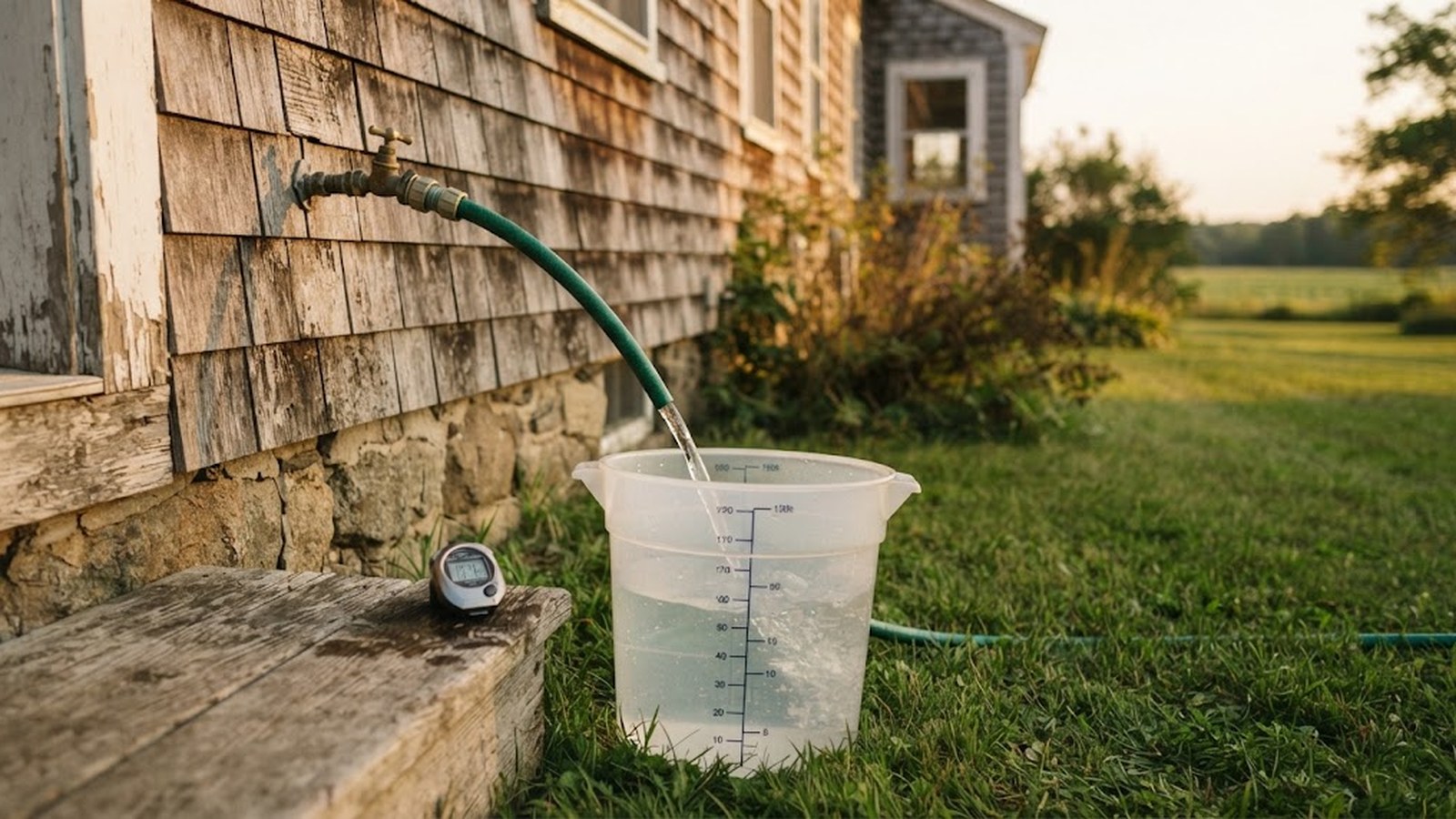
Time a bucket fill. Pick an outdoor faucet, a bucket of a known size, and a stopwatch. Fill the bucket and note how long it took. Do it the same way each time, ideally in the same season. This does not measure yield, since it reflects the whole system, but a big change from one year to the next is a signal worth following up on.
Record unusual events. Write down any time the water sputtered, ran out, turned cloudy after heavy use, or the pump seemed to run for an unusually long time. Note the date, the weather, and what was happening in the house.
Note changes in household use. A new family member, a new garden, a hot tub, or a home business can change your demand. Having that in your log helps explain changes in how the system behaves.
Keep professional reports with it. Any flow test, pump service invoice, or well inspection belongs in the same folder.
Over several years, a log like this becomes a kind of health chart for your well. It is also exactly the kind of history future buyers appreciate.
Picture your well as a bank account to see why it fits some families, not others
Here is a simple analogy. Think of your well as a bank account that receives small deposits all day long from the surrounding groundwater. The yield is the size of those deposits. The water stored in the well and in any storage tank is your balance. Your household's water use is your spending.
If you spend a little at a time, even small deposits keep the balance healthy. If you spend a lot all at once, you can draw the balance down faster than the deposits refill it. A flow test is like looking at the account's recent deposit history. It tells you a lot, but the deposits can shrink during dry times, and your spending habits matter just as much as the deposit size.
This is not a technical model, but it captures why the same well can be perfect for one family and frustrating for another.
Get quick answers to common flow test questions
Is a flow test the same as a water test?
No. A flow test looks at how much water the well and system deliver. A water test, done by a certified laboratory, looks at what is in the water. Most buyers benefit from both.
Who performs flow tests?
It depends on the area. Well contractors, pump service companies, and some home inspectors offer them. Ask what type of test they perform and what it measures.
Can a low-yield well still work for a family?
Often, yes. Storage tanks, sensible habits, and a well-matched pump can let a modest well serve a household comfortably. A well professional can explain the options for a specific property.
Review the key points, then decide your next step
Water quantity deserves the same attention as water quality. Yield is the rate a well can supply water, and it can vary with geology, season, drought, and the well's condition. A flow test is a snapshot of how the well and system behave under a certain load, and it is most useful when you know what type of test was done, how long it ran, and what was measured.
If you are buying, ask the seller about any history of running short, check for a well construction record, find out whether local or lender rules apply, and consider having a qualified professional evaluate the well's performance. If the numbers are modest, remember that the match between the well and your household is what counts, and that storage, maintenance, and habits can make a big difference. Evidence first, decisions second, whether the question is what is in your water or how much of it you will have.