
Well Care · Caring for Your Well
Hiring a Well or Pump Contractor for a Repair
When your water stops or the pump acts up, you need help fast, but you still want the right help. Here is how to find a qualified well or pump contractor, describe the problem clearly, and understand what you are agreeing to.
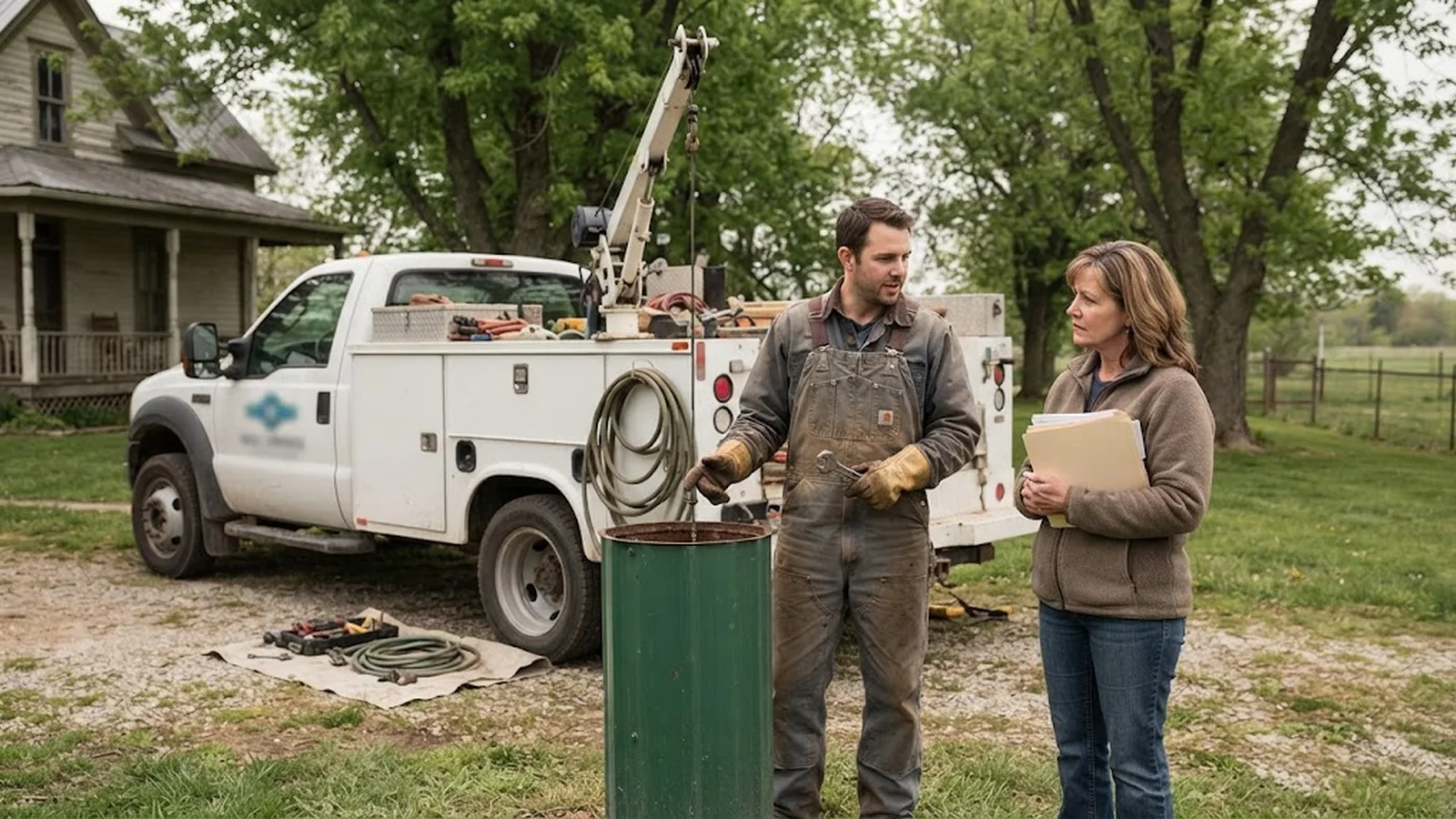
Nobody plans to hire a well contractor. It usually happens on a Sunday morning when the shower sputters and dies, or when the pump has been clicking on and off all night and you finally admit it is not going to fix itself. In that moment, you want someone who can come quickly. You also want someone who knows what they are doing, will tell you the truth about what is wrong, and will not leave you with a bill you did not expect.
This guide walks you through hiring a well or pump contractor for repair work: who does this kind of work, how to check them out quickly, how to describe what is happening, and what to ask before and after they do the job. It is not about drilling a new well. If that is where you are headed, our guides on planning your first well and comparing well drilling quotes cover that side.
Who actually does well and pump repair
You will hear a few different job titles, and the lines between them are not always sharp.
Well drillers build and modify wells. Many drilling companies also do service work, especially on the parts down inside the well.
Pump installers or pump service companies work on pumps, pressure tanks, pressure switches, controls, and the plumbing that connects the well to the house.
Plumbers may handle the household side of the system, and some plumbers work on well equipment too, depending on local licensing.
Electricians may be needed for the pump circuit or controls, depending on what is wrong and what local rules allow.
Water treatment companies install and service filters, softeners, and similar equipment. They are a different trade from well and pump service, even if they show up in the same basement.
When your water stops, the call usually goes to a well or pump service company first. They can figure out where the problem is and bring in other trades if needed.
Find a few names before you need one
The best time to choose a well contractor is before anything breaks. If you are reading this while the water is still running, take a few minutes now.
The Water Systems Council, a national organization focused on private wells, suggests getting referrals from neighbors, your state's well drillers or groundwater association, your local health department, or its own wellcare hotline. Neighbors are especially helpful in rural areas, because they know who actually shows up.
Once you have two or three names, save their numbers somewhere easy to find. A strip of tape on the side of the pressure tank with a company name and number is a classic for a reason.
Check credentials, even when you are in a hurry
Checking a contractor does not have to take long. A few minutes can save you real trouble.
Licensing or registration. The Water Systems Council says your well contractor should be certified, licensed, or registered with the state health or environmental agency. Requirements vary by state. Many states have an online lookup. Ask for the license number and check it.
Insurance. The same guidance says a well company and its people should be insured. Ask whether they carry liability insurance. If they are working on your property with heavy equipment, this matters.
Experience in your area. Ask how long they have worked locally. Local experience means they are more likely to know common well types, typical depths, and local rules.
References. It is reasonable to ask for a couple of references, especially for larger jobs. For an emergency service call, a quick look at reviews and a recommendation from a neighbor may be all you have time for, and that is fine.
Describe the problem clearly
The more clearly you describe what is happening, the better the contractor can prepare, and the more likely they are to bring the right parts the first time. You do not need technical words. Just describe what you see, hear, and notice.
Useful details to share:
- What is happening. No water at all? Low pressure? Water that comes and goes? Air spitting from faucets? Cloudy or gritty water?
- When it started. Suddenly or over time? After a storm, a power outage, or other work on the property?
- Where it happens. Every faucet, or only some? Hot and cold, or just one?
- What the pump seems to be doing. Do you hear it running constantly, clicking on and off quickly, or not at all?
- What the pressure gauge shows, if you know where it is. Our article on your pressure tank explains what the gauge is and why it matters.
- Whether a breaker has tripped, and whether it tripped again after you reset it.
- What you know about the system. Age of the pump or tank if you know it, the type of well, and when it was last serviced.
If you have records, have them ready. A well construction record, past service invoices, and test results all help.
Photos help too. Many contractors are happy to receive a photo of your pressure tank, gauge, switch, and wellhead before they arrive.
A few things to do (and not do) while you wait
Safety first. Well systems involve electricity and water under pressure.
- If a breaker keeps tripping, leave it off and wait for the professional. Resetting it over and over is not a good idea.
- If the pump seems to be running nonstop without building pressure, many professionals will want it turned off at the breaker until they can look. Ask the contractor when you call.
- Do not open the pressure switch or electrical boxes unless you are qualified to do so.
- Do not remove the well cap or try to work on anything inside the well.
- Keep the area clear so the contractor can reach the wellhead and the pressure tank.
For water to drink and cook with while you wait, stored water or bottled water is the simple answer. Our power outage guide has practical ideas for getting by without running water.
Before the work starts
When the contractor arrives and figures out what is wrong, a short conversation before work begins prevents most surprises.
Ask what they found. Have them explain the problem in plain language. A good contractor will happily show you the part that failed or the reading that worries them.
Ask what they recommend and why. If there is more than one way to fix it, ask what the options are.
Ask what it will cost, at least roughly. For simple repairs, you may get a firm price. For work that involves pulling the pump out of the well, the final cost can depend on what they find. Ask how they handle that.
Ask whether anything else should be done at the same time. Sometimes it makes sense to replace related parts while the system is open. Sometimes it does not. Ask them to explain the tradeoff rather than just adding it on.
Ask who handles permits or notifications, if any are needed for the type of work. The Water Systems Council suggests talking through who is responsible for each part of the work before you sign anything.
Get it in writing. The same guidance notes that a professional well contractor uses a written contract describing the job and any warranties. For a small service call, that might be a work order or estimate. For bigger work, ask for something more detailed.
If the repair is large, like replacing the pump or doing work on the well itself, and the situation is not an emergency, it is reasonable to get a second opinion. If you are without water, you may not have that luxury, and that is understandable.
Questions about pulling the pump
When a submersible pump needs to be serviced or replaced, it has to be pulled up out of the well. That is a bigger job than working on parts in the basement.
Questions worth asking:
- What equipment do you need to get to the wellhead, and is there anything I should move?
- What will the yard look like afterward?
- Will you replace the pump with the same type and size, or do you recommend something different? Why?
- Will anything else be replaced while the pump is out?
- What is the warranty on the pump and on your labor?
Let the contractor size and select the equipment. Choosing pumps and tanks is a technical job that depends on your specific well.
Ask about the water after the work
Any work that opens the well or plumbing can affect the water. The CDC lists repairing or replacing part of the well system as one of the reasons to test your well water more often.
Before the contractor leaves, ask:
- Do you recommend disinfecting the system after this work? Some contractors include this, others do not, and local rules may apply. Let the professional or your health department guide this step.
- When should I test the water? If testing is recommended, ask how long to wait.
- Is there anything I should watch for in the next few days? Cloudiness, air, or pressure changes after some repairs can be normal for a short time, or a sign something needs another look. Ask what is normal for the job they did.
Then follow through with testing through a certified laboratory. Our testing page explains how to choose a lab.
After the job: keep the paperwork
The Water Systems Council's well owner's manual is direct about this: always keep good well records. That includes repair bills and information on equipment purchases.
From every service call, try to keep:
- The invoice or work order
- What was found and what was done
- Make and model of any new equipment
- Any settings the contractor mentions, like pressure switch settings
- Warranty details
- The contractor's name and contact information
- Any test results that followed
These records help the next contractor diagnose problems faster, help you track how old your equipment is, and help a future buyer trust the house. Our guide to your first 30 days in a home with a well has a simple way to set up a records binder if you do not have one yet.
Warning signs to take seriously
Most contractors are honest people doing hard work. But it helps to know what to watch for.
- No license, or reluctance to share one, in a state that requires it.
- Pressure to make a big decision on the spot when it is not an emergency.
- Recommendations that do not match the problem. If you called about a pump that will not shut off and the conversation turns to a whole-house treatment system you never asked about, slow down.
- Vague estimates for big jobs with no explanation.
- Unwillingness to explain what was found or show you old parts.
If something feels off, you can pause, ask for a written estimate, and get another opinion.
Planning ahead: routine checkups
Repairs are easier to handle when you already have a relationship with a contractor. The Water Systems Council recommends having a qualified well driller or pump installer periodically inspect the whole system, including the pump, tank, pipes, valves, and water flow. If you have no idea when your system was last looked at, a checkup is a good way to establish a baseline and meet a contractor before you need one in a hurry.
Ask your contractor how often they suggest a checkup for your system, and add it to your calendar alongside annual water testing.
Quick answers
Should I call a plumber or a well company?
If the problem seems to involve the pump, pressure tank, pressure switch, or water coming from the well, a well or pump company is usually the right first call. If it is clearly limited to a fixture or pipe inside the house, a plumber may be right.
Can I replace a pressure switch or tank myself?
These parts involve electricity and pressurized water, and many states regulate who can work on well systems. Unless you are qualified, leave it to a professional.
What if the contractor says I need a new well?
That is a big decision. Ask why, ask for it in writing, and get a second opinion if your situation allows. Our guide to comparing well drilling quotes can help if you go that route.
The short version
Find two or three qualified well and pump contractors before you need one. Check their licensing and insurance. When something goes wrong, describe what you see and hear as clearly as you can, keep the system safe, and let the professional diagnose it. Ask what they found, what they recommend, and what it will cost before work starts. Ask about disinfection and testing afterward, and keep every piece of paperwork.
Do those things, and a bad morning with no water becomes a manageable repair instead of a mystery.